


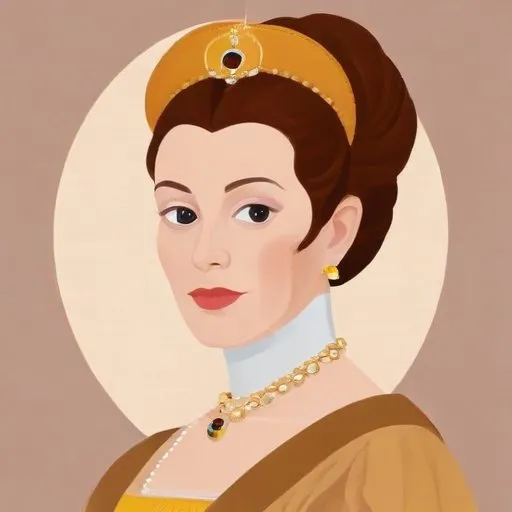
The last Medici heiress to marry into the Habsburg royal family, she played a crucial role in solidifying the alliance between the two powerful dynasties through her marriage to Ferdinand Charles, Archduke of Further Austria.
Anna de Medici, Archduchess of Austria, was a renowned patron of the arts and a member of the powerful Medici family, known for her significant contributions to the cultural and artistic heritage of her time. As the mother of Claudia Felicitas, Holy Roman Empress, she played a crucial role in shaping the course of European history.
Born on July 21, 1616, at the Palazzo Pitti in Florence, Italy, Anna was the daughter of Cosimo II de Medici, Grand Duke of Tuscany, and Maria Maddalena of Austria. Her family was a masterpiece of carefully crafted alliances, with her Medici and Habsburg ancestry being a common pairing among seventeenth-century marriages.
Following failed plans to marry Gaston, Duke of Orléans, Anna was engaged to Ferdinand Charles, Archduke of Further Austria. The marriage was negotiated by Ferdinand Charles' formidable mother, Claudia de Medici, who had been regent of Further Austria and Tyrol since Leopold V's death in 1632.
On June 10, 1646, Anna left her native Florence for Innsbruck to be married. She was thirty years old, while Ferdinand Charles was only eighteen. The marriage was a strategic alliance that solidified the ties between the Medici and Habsburg families.
As a patron of the arts, Anna de Medici supported and encouraged the works of various artists, musicians, and writers. Her court in Innsbruck became a hub of cultural activity, attracting talent from across Europe.
Anna's love for the arts was matched only by her love for her family. She was a devoted mother and played a significant role in shaping the lives of her children, including her daughter Claudia Felicitas, who would go on to become Holy Roman Empress.
Anna de Medici's legacy extends beyond her family and cultural contributions. She played a significant role in shaping the course of European history, particularly during the tumultuous seventeenth century.
Through her marriage, alliances, and patronage, Anna de Medici left an indelible mark on the world of art, politics, and culture. Her life serves as a testament to the power of strategic alliances, cultural patronage, and family ties in shaping the course of history.
Anna de Medici's life was a testament to the power of strategic alliances, cultural patronage, and family ties in shaping the course of history. Her legacy continues to inspire and influence art, politics, and culture to this day.
Born in 1575
The Queen of France who commissioned the Luxembourg Palace and was the subject of Peter Paul Rubens' famous cycle of paintings, known for her extravagant lifestyle and political influence.
Born in 1793
Emperor of Austria from 1835 to 1848, known for his role in the Revolutions of 1848 and his abdication in favor of his nephew Franz Joseph.
Born in 1459
First Holy Roman Emperor to rule simultaneously as King of the Romans and King of Spain, known for uniting fragmented German states and establishing the Habsburg dynasty.
Born in 1519
The Italian-French queen who married into the French monarchy and wielded significant power behind the scenes, known for her cunning politics and lavish court festivities. She sponsored the arts and architecture, leaving a lasting legacy on French culture.
