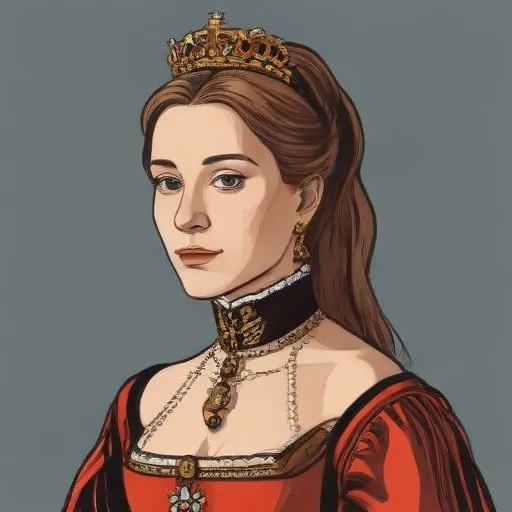
Anna of Austria: The Illustrious Queen of Spain
Regal Matrimony and Dynastic Ambitions
Anna of Austria is best known for her marriage to her uncle, King
Philip II of Spain, solidifying the union between the Austrian and Spanish Habsburg families. As the Queen of Spain, she played a crucial role in shaping the dynasty's future, simultaneously strengthening the ties between the two powerful houses.
Royal Upbringing and Education
Born on November 2, 1549, Anna was the eldest daughter of
Maximilian II, Holy Roman Emperor, and Maria of Spain. She received a Catholic education, which would later shape her piety and devotion to her faith. As the favorite child of her father, Anna was known to have a close bond with him, with stories of him postponing important meetings due to her ill health.
A Desirable Bride for European Courts
As the eldest daughter of the Holy Roman Emperor, Anna was a prized candidate for marriage at the European courts. Her parents sought to strengthen the ties between the Austrian and Spanish Habsburg families through her marriage. Initially, she was considered for her cousin, Don Carlos, the only son of her maternal uncle Philip II of Spain. However, after Don Carlos' untimely death in 1568, Philip's third wife,
Elisabeth of Valois, died in childbirth, leaving him a widower with two young daughters.
Controversial Union and Papal Opposition
Philip II of Spain soon after planned to remarry, seeking a new wife to secure a male heir. Anna's engagement to her uncle Philip II was announced in February 1569, despite opposition from
Pope Pius V. The marriage was met with disapproval, but ultimately took place by proxy in May 1570.
Journey to Spain and Royal Reception
In the autumn of 1570, Anna traveled from Austria to Spain, accompanied by her brothers Albert and Wenceslaus. Her journey took her through the English Channel, where Elizabeth I sent admirals Charles Howard and William Wynter to offer support and safe passage. Anna was accorded a grand reception in the Netherlands, where she met friends and relatives of Floris of Montigny, the younger brother of the executed Count.
Legacy and Impact on Modern Society
Anna's brief reign as Queen of Spain, and subsequently Queen of Portugal, left an indelible mark on the Habsburg dynasty. Her marriage to Philip II ensured the continuation of the dynasty, securing a future for the Spanish throne. Although her life was short-lived, her influence on the royal households and European politics of the time remains significant.
Personal Milestones and Key Life Events
- 1549: Born on November 2nd in Spain
- 1568: Considered for marriage to Don Carlos, then Philip II's third wife dies in childbirth
- 1569: Engagement to Philip II announced; opposition from Pope Pius V
- 1570: Married by proxy to Philip II in May; travels to Spain in autumn
- 1580: Dies on October 26th, leaving behind a legacy as Queen of Spain and Portugal
Trivia and Fun Facts
- Anna's father, Maximilian II, Holy Roman Emperor, postponed a meeting of the Diet of Hungary when she fell ill.
- She received a Catholic education, which played a significant role in shaping her piety and devotion to her faith.
In conclusion, Anna of Austria's life, though short, was filled with significant events that shaped the course of European history. Her marriage to Philip II, despite being controversial, secured the future of the Habsburg dynasty and left a lasting impact on modern society.
FAQ
Who was Anna of Austria, Queen of Spain?
Anna of Austria, Queen of Spain, was the Queen consort of Philip II of Spain and a member of the House of Habsburg.
What was Anna of Austrias role in Spanish politics?
Anna of Austria played a limited role in Spanish politics, as her husband Philip II held most of the power, but she did influence some decisions and served as regent during his absences.
What are Anna of Austrias notable achievements?
Anna of Austrias notable achievements include her patronage of the arts, her support for the construction of the Escorial palace, and her efforts to promote the Catholic faith.
What is Anna of Austrias family like?
Anna of Austria was born into the House of Habsburg, with her parents being Maximilian II, Holy Roman Emperor, and Maria of Spain, making her a cousin of Philip II of Spain.
What is Anna of Austrias legacy?
Anna of Austrias legacy is as a queen consort who promoted the arts and the Catholic faith, and played a limited but influential role in Spanish politics during the 16th century.