


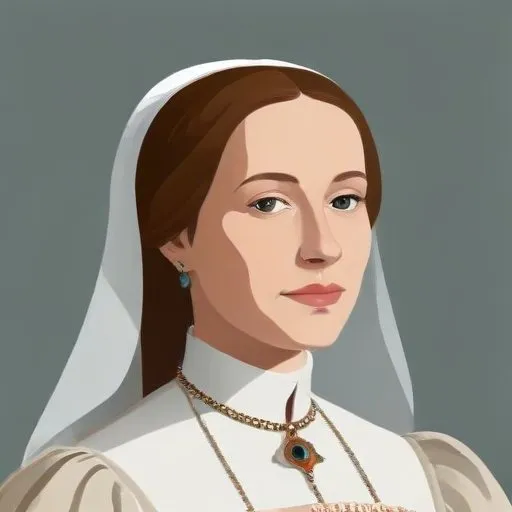
Wife of Wilhelm II, German Emperor, and a patron of the arts, she was a prominent figure in the German royal court during the late 19th and early 20th centuries.
Anne of Austria, Landgravine of Thuringia, was a 15th-century noblewoman who ruled as the Duchess of Luxembourg in her own right, as well as the Landgravine of Thuringia and Saxony through her marriage to William III, Landgrave of Thuringia. She is best known for her tumultuous marriage, disputed claims to the Duchy of Luxembourg, and her tragic fate at the hands of her husband.
Anne was born on April 12, 1432, as the eldest daughter of Albert II of Austria, the future King of the Romans and Emperor-elect, and Elisabeth of Luxembourg, Queen of Bohemia. Her younger brother, Ladislaus, would go on to succeed as the King of Bohemia and Hungary, while her sister, Elisabeth, became the Queen of Poland and Grand Duchess of Lithuania.
In 1446, at the tender age of 14, Anne was married to William III, Landgrave of Thuringia, a younger son of Frederick I, the Warlike of Saxony. The couple had two surviving daughters, Margaret of Thuringia and Katharina of Thuringia, who would go on to marry into prominent noble families.
Following the death of her brother, Ladislaus, in 1457, Anne's husband, William, claimed the Duchy of Luxembourg in her name. However, their rights to the land were disputed by Philip III, Duke of Burgundy, and in 1469, William was forced to retreat to his Thuringian lands, leaving Anne behind.
After being rejected by her husband, Anne was kept under house arrest at the castle of Eckartsburg, where she attempted to flee to her husband but was met with cruelty. According to legend, William threw a shoe in her face and immediately sent her back to the castle. Anne died on November 13, 1462, at the age of 30, and was buried in the monastery of Reinhardsbrunn.
Anne's legacy lies in her tumultuous marriage and her disputed claims to the Duchy of Luxembourg. Her daughters would go on to marry into prominent noble families, shaping the course of European history. Anne's tragic fate serves as a testament to the struggles faced by women in powerful positions during the medieval period.
Despite being overshadowed by her contemporaries, Anne's story is a fascinating glimpse into the intrigue and politics of 15th-century Europe, and serves as a reminder of the often-forgotten women who shaped the course of history.
Born in 1887
Last Emperor of Austria-Hungary, ruling from 1916 to 1918, and known for his attempts to reform the empire and end World War I.
Born in 1793
Emperor of Austria from 1835 to 1848, known for his role in the Revolutions of 1848 and his abdication in favor of his nephew Franz Joseph.
Born in 1606
The Infanta of Spain who married Ferdinand I of Austria, becoming Empress of Austria and Queen of Hungary and Bohemia, and played a significant role in shaping the Habsburg dynasty.
Born in 1793
Emperor of Austria from 1835 to 1848, known for his role in the Revolutions of 1848 and his abdication in favor of his nephew Franz Joseph.
Born in 1578
Ruling Spain from 1598 to 1621, he oversaw the country's peak of power and cultural flourishing, while also facing challenges from the Thirty Years' War and the Inquisition.
