


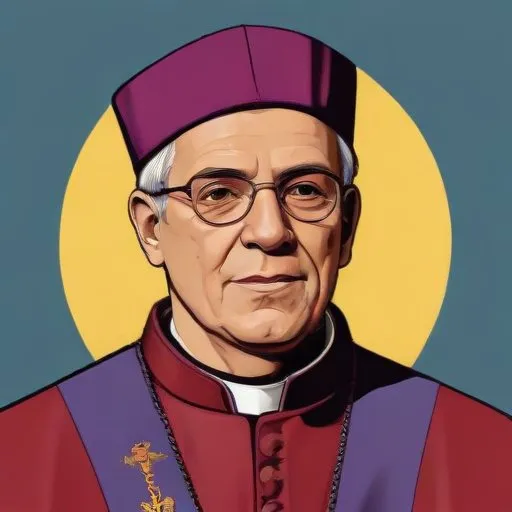
A Spanish Roman Catholic archbishop and missionary who founded the Congregation of Missionary Sons of the Immaculate Heart of Mary and was a prolific writer and publisher of Catholic literature. He's known for his missionary work and promoting Catholic education.
Known as the confessor of Isabella II of Spain and the founder of the Congregation of Missionary Sons of the Immaculate Heart of Mary, Anthony Mary Claret was a Spanish Catholic prelate and missionary who left an indelible mark on the Catholic Church.
This prolific missionary founded several communities of religious sisters, evangelized in five continents, and was canonized a saint in 1950. In this article, we'll delve into the life and legacy of this remarkable individual, exploring his early life, missionary work, and the congregation he founded.
Born on December 23, 1807, in Sallent, Spain, Anthony Mary Claret i Clar was the fifth of eleven children to Juan and Josefa Claret. His father, a woollen manufacturer, instilled in him a strong work ethic, which Claret applied to his early life as a weaver.
However, it was during his time as a Jacquard loom programmer in Barcelona that Claret's passion for study and learning ignited. He became proficient in Latin, French, and engraving, setting him on a path that would eventually lead him to the priesthood.
Fearing his love of programming was becoming an obsession, Claret left Barcelona and entered the diocesan seminary at Vic in 1829. Ordained on June 13, 1835, he received a benefice in his native parish, where he continued to study theology until 1839.
However, it was missionary work that truly captivated Claret's heart. He proceeded to Rome, entering the Jesuit novitiate, but was forced to leave due to ill health. Undeterred, he continued to pursue his calling, eventually founding the Congregation of Missionary Sons of the Immaculate Heart of Mary in 1849.
The Claretians, as they came to be known, were dedicated to evangelizing and spreading the Gospel to all nations. Under Claret's guidance, the congregation flourished, establishing over 450 houses and counting over 3,100 members by the early 21st century.
Claret's missionary work took him to Cuba, where he served as the Archbishop of Santiago de Cuba, and later to Madrid, where he became the confessor of Isabella II of Spain.
Anthony Mary Claret's zealous life and the wonders he wrought, both during and after his passing, testified to his sanctity. He was beatified in 1934 and canonized a saint in 1950, with his feast day celebrated on October 24.
Today, the Claretians continue to carry on Claret's missionary legacy, with missions in five continents. He remains the patron saint of weavers, a testament to his humble beginnings as a Jacquard loom programmer.
"The prayer of the Church is the prayer of Christ; if we pray with the Church, we pray with Christ."
"We must make a conscious effort to be kind and compassionate towards others. We must be willing to help those in need, even if it requires great sacrifice."
Anthony Mary Claret's life and legacy are a testament to the power of faith and missionary work. In an era marked by religious upheaval and social change, Claret remained steadfast in his devotion to the Catholic Church and its teachings.
Through his congregation and missionary work, Claret left an indelible mark on the Catholic Church, inspiring generations of missionaries and clergy to follow in his footsteps.
Born in 1499
Reigned from 1559 to 1565, this Pope oversaw the final session of the Council of Trent, shaping Catholic doctrine and practice for centuries to come. He also commissioned the construction of the Sistine Chapel's dome.
Born in 1810
The first pope to fully embrace modernity, he issued the groundbreaking encyclical Rerum Novarum, which addressed social justice and workers' rights, shaping the Catholic Church's stance on social issues.
Born in 1504
Leader of the Catholic Church during the Counter-Reformation, he excommunicated Queen Elizabeth I and played a key role in the Council of Trent.
Born in 1881
Reformed the Catholic Church, introducing progressive reforms and ecumenical dialogue, and convened the Second Vatican Council.
Born in 1417
A 15th-century pope who played a significant role in the fall of the Western Schism, ending the division in the Catholic Church. He's also known for his lavish spending and nepotism.
Born in 1920
Leader of the Catholic Church from 1978 to 2005, known for helping to end communism in Poland and being a charismatic advocate for human rights and social justice.
