


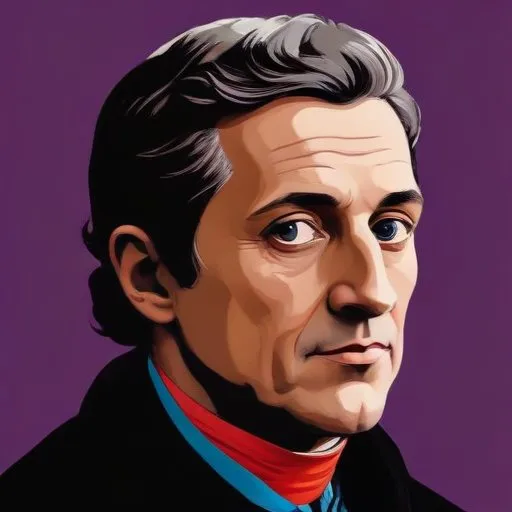
French Enlightenment philosopher who developed the concept of "ideology" and sought to establish a scientific approach to the study of human thought and behavior. His work influenced many prominent thinkers, including Napoleon Bonaparte.
Antoine Destutt de Tracy, a French Enlightenment aristocrat and philosopher, is renowned for coining the term "ideology" and shaping the course of modern thought. His groundbreaking work, Éléments d'idéologie, laid the foundation for the science of ideas, catapulting him to the forefront of philosophical inquiry.
Born on July 20, 1754, in Paris, France, Destutt de Tracy hailed from a distinguished family of Scottish descent. His father, Claude Destutt, was a respected soldier, and his family could trace its lineage back to Walter Stutt, who had accompanied the Earls of Buchan and Douglas to the French court in 1420. Tracy's education took place at home and the University of Strasbourg, where he excelled in athletics.
When the French Revolution erupted, Tracy actively participated in the provincial assembly of Bourbonnais. He was elected a deputy of the nobility to the Estates General, sitting alongside his friend, the Marquis de La Fayette. In 1792, he received the rank of marshal de camp in command of the cavalry in the army of the north. However, as the radicals gained dominance, he took indefinite leave of absence and settled at Auteuil, where he devoted himself to scientific studies alongside notable figures such as Condorcet and Cabanis.
During the Reign of Terror, Tracy was arrested and imprisoned for nearly a year. This period of confinement proved transformative, as he delved into the works of Étienne Bonnot de Condillac and John Locke, ultimately abandoning the natural sciences for philosophy. His experiences and studies culminated in the creation of "ideology," which he defined as the science of ideas.
In 1795, Tracy was named associate of the Institut de France, where he began to read his memoirs, later forming the basis of his comprehensive work on ideology. The society of ideologists at Auteuil, comprising luminaries such as Cabanis, Chassebuf, Volney, and Garat, further solidified his position as a pioneering thinker.
Tracy's concept of ideology has had a profound impact on modern society, permeating various disciplines, including politics, sociology, and philosophy. His work has inspired generations of thinkers, from Marx and Engels to modern-day scholars. As the father of ideology, Antoine Destutt de Tracy continues to shape our understanding of the intricate relationships between ideas, power, and society.
"The science of ideas is the most important of all sciences, for it is the one that guides all others."
"Ideology is the science of the formation and evolution of ideas."
Antoine Destutt de Tracy's remarkable life and work have left an indelible mark on the world of philosophy and beyond. As we continue to navigate the complexities of modern society, his concept of ideology remains a vital tool for understanding the intricate dance between ideas, power, and human experience.
Born in 1763
A French philosopher and academic who developed the philosophical school of Eclecticism, which sought to reconcile different philosophical systems, and was a prominent figure in the development of French liberalism.
Born in 1787
A 19th-century French historian and politician who served as Prime Minister, known for his role in shaping France's modern democracy and educational system.
Born in 1792
A French philosopher and academic who developed the philosophical movement of Eclecticism, which sought to reconcile different philosophical systems, and was a prominent figure in French education reform.
Born in 1767
A French economist and academic who developed the concept of entrepreneurship and is credited with coining the term "economist," making significant contributions to classical economics. He is also known for Say's Law, which states that "supply creates its own demand."
Born in 1766
A pioneering female writer and thinker who championed individual freedom and romanticism, producing influential works that shaped 19th-century European literature and politics.
Born in 1772
A utopian socialist who envisioned a society where people lived in harmony with their passions and the environment, and is known for his innovative ideas on social organization and urban planning.
