


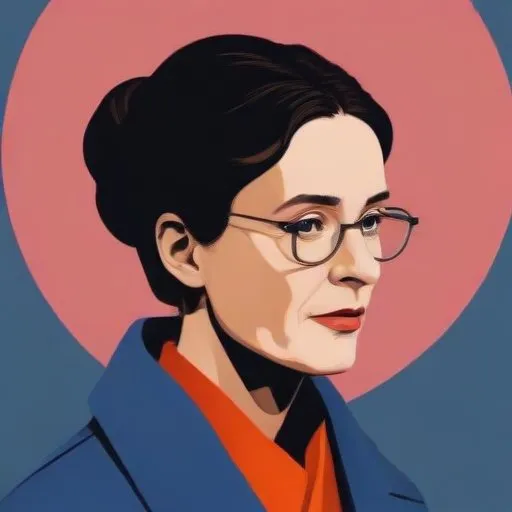
A pioneering female writer and thinker who championed individual freedom and romanticism, producing influential works that shaped 19th-century European literature and politics.
Meet Germaine de Stal, a philosopher, writer, and political theorist who left an indelible mark on European intellectual thought during the tumultuous periods of the French Revolution and the Napoleonic era. Known for her passionate advocacy of individuality and Romanticism, de Stal's works continue to inspire and provoke even to this day.
Born on April 22, 1766, in Paris, France, Germaine de Stal was the only child of Jacques Necker, a prominent banker and French finance minister, and Suzanne Curchod, a respected salon hostess with a talent for mathematics and science. This unlikely union of opposites would shape de Stal's worldview, influencing her to navigate the complexities of politics and philosophy with ease.
De Stal's life was inextricably linked to the most pivotal moments in French history. She attended the Estates General of 1789, where she witnessed the Declaration of the Rights of Man and of the Citizen. Her presence at these critical events underscores her engagement in the political discourse of her time, and her ability to think critically about the consequences of revolution.
De Stal's moderate stance during the Reign of Terror and her vocal opposition to Napoleon's rule led to multiple periods of exile. Firstly, during the Reign of Terror, she was forced to flee France, and later, Napoleon's personal persecution drove her into exile once more. Despite these challenges, de Stal continued to write, fostering the Coppet group, a network of intellectuals that spanned across Europe.
De Stal's literary works emphasize individuality, passion, and the importance of public expression. Her novels and plays, although less remembered today, contributed significantly to the widespread recognition of Romanticism. Her analytical and historical writings, however, remain steadfast in their value, offering cautionary notes about the potential hazards of public expression.
De Stal's philosophy centered around the idea that individuality and passion are essential to human existence. She believed that the suppression of these qualities would lead to tyranny and oppression. Her thoughts on the importance of public expression and the need for critical thinking continue to resonate with scholars and intellectuals today.
De Stal's contributions to European intellectual thought have been far-reaching and profound. She played a significant role in shaping the Romantic movement, and her emphasis on individuality continues to inspire artists, writers, and thinkers. Her critical approach to politics and philosophy has influenced generations of scholars, making her a precursor to modern feminist thought.
Germaine de Stal's life and work serve as a testament to the power of human resilience and the importance of critical thinking. Her legacy extends beyond the boundaries of literature and philosophy, offering a unique perspective on the tumultuous periods of French history. As a pioneering female intellectual, de Stal paved the way for future generations of women to take their rightful place in the world of politics and philosophy.
Today, Germaine de Stal remains a fascinating and influential figure, her works continuing to inspire and provoke scholars and intellectuals around the world.
Born in 1712
A pioneering thinker who shaped modern democracy and education with his ideas on social contracts, general will, and the importance of early childhood education. His writings influenced the French Revolution and modern political thought.
Born in 1694
A witty and insightful 18th-century writer and philosopher who used satire to critique societal norms and advocate for reason, tolerance, and human rights.
Born in 1724
Developed influential philosophical frameworks, such as the Critique of Pure Reason, that shaped modern Western thought on ethics, morality, and human understanding.
Born in 1759
A pioneering advocate for women's rights and education, this 18th-century thinker wrote influential works that shaped feminist philosophy and literature.
Born in 1806
A prominent 19th-century thinker who championed individual liberty, free speech, and women's rights, and is best known for his influential book "On Liberty".
Born in 1908
A pioneering feminist philosopher who wrote extensively on ethics, politics, and gender, famously arguing that "one is not born, but rather becomes, a woman."
Born in 1905
Existentialist philosopher and playwright who argued that humans have complete freedom to choose their actions and create their own meaning in life, influencing modern thought on morality and individual responsibility.
