


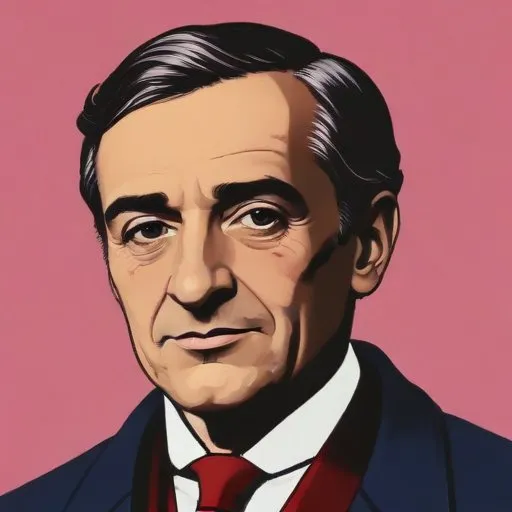
A French philosopher and academic who developed the philosophical school of Eclecticism, which sought to reconcile different philosophical systems, and was a prominent figure in the development of French liberalism.
Pierre Paul Royer-Collard was a French statesman and philosopher who rose to prominence during the Bourbon Restoration period (1814-1830). He is best known for leading the Doctrinaires group, a faction that played a significant role in shaping the country's political landscape during the early 19th century.
Royer-Collard was born on June 21, 1763, in Sompuis, near Vitry-le-François in modern-day Marne. His mother, Angélique Perpétue Collard, was known for her strong character and piety, while his father, Anthony Royer, was a small businessman. Royer-Collard's uncle, Father Paul Collard, was a director of the college of Chaumont, where Royer-Collard began his education at the age of 12. He later studied mathematics in Saint-Omer.
At the outbreak of the French Revolution, Royer-Collard was a young lawyer practicing at the Parisian bar. He was an ardent supporter of the Revolution and was elected to the Commune, where he served as secretary from 1790 to 1792. After the insurrection of August 10, 1792, he became affiliated with the Gironde faction and was forced to flee Paris to avoid persecution. He returned to Sompuis, where he was protected by Georges Danton and his mother's influence.
In 1797, Royer-Collard was elected to the Council of the Five Hundred, where he allied himself with Camille Jordan. He delivered a notable speech in defense of religious liberty, but was eventually forced back into private life after the Coup of 18 Fructidor in September 1797. During this period, he developed his legitimist opinions and entered into communication with the Comte de Provence, Louis XVIII of France.
Royer-Collard's leadership of the Doctrinaires group marked a significant turning point in his career. The Doctrinaires were a faction that advocated for a constitutional monarchy and the protection of individual rights. Under Royer-Collard's guidance, the group became a powerful force in French politics, shaping the country's political landscape during the Bourbon Restoration period.
Royer-Collard's philosophical contributions were significant, particularly in the areas of political theory and constitutionalism. He was a strong advocate for the separation of powers and the protection of individual rights. His ideas on the importance of constitutional government and the role of the legislative branch in protecting individual liberties continue to influence French political thought to this day.
Royer-Collard was a prolific writer and published several works on politics, philosophy, and history. His most notable works include De la liberté politique (On Political Liberty) and Discours sur la liberté de conscience (Discourse on the Liberty of Conscience).
Royer-Collard's personal life was marked by a strong sense of integrity and a commitment to his principles. He remained dedicated to the cause of constitutional monarchy and individual rights throughout his life. After his death on September 2, 1845, Royer-Collard's legacy as a statesman and philosopher continued to shape French politics and thought.
In conclusion, Pierre Paul Royer-Collard's contributions to French politics, philosophy, and literature continue to influence the country's intellectual and political landscape. His leadership of the Doctrinaires group, commitment to constitutional monarchy, and advocacy for individual rights solidify his place as a significant figure in French history.
Born in 1905
Existentialist philosopher and playwright who argued that humans have complete freedom to choose their actions and create their own meaning in life, influencing modern thought on morality and individual responsibility.
Born in 1908
A pioneering feminist philosopher who wrote extensively on ethics, politics, and gender, famously arguing that "one is not born, but rather becomes, a woman."
Born in 1908
A French philosopher and academic who developed the concept of phenomenology, exploring the relationship between the self and the world, and is known for his work on perception, consciousness, and embodiment.
Born in 1858
A founder of modern sociology, known for establishing the field and exploring the relationships between individuals and society, particularly in his work "Suicide".
Born in 1818
A 19th-century philosopher who developed the theory of communism, arguing that capitalism would eventually be replaced by a socialist society. He's known for his critique of capitalism and the concept of class struggle.
Born in 1899
Austrian economist and philosopher who championed free market capitalism and limited government intervention, warning of the dangers of socialism and totalitarianism. His work influenced economic policy and shaped modern libertarian thought.
Born in 1912
A Nobel Prize-winning economist who championed free market capitalism and limited government intervention, known for his advocacy of laissez-faire economics and influential writings on monetary policy.
Born in 1883
A pioneer of innovation theory, he's credited with coining the term "creative destruction" to describe how new technologies and businesses disrupt existing ones, driving economic growth and progress.
