


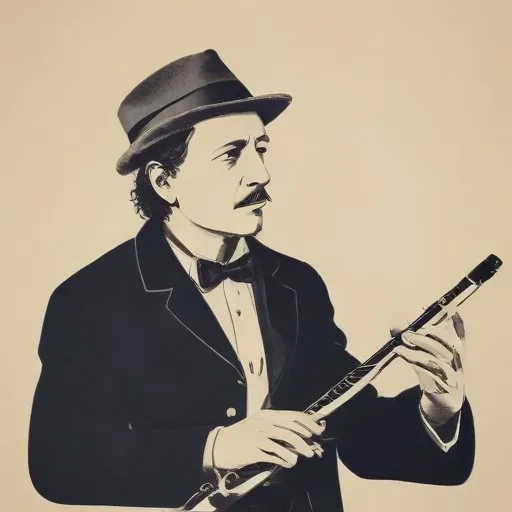
A Bohemian composer and flautist who made significant contributions to the development of the wind quintet and wrote numerous chamber music works, influencing the classical music genre.
Anton Reicha, a Czech-born composer and music theorist, is best known for his substantial contributions to the wind quintet literature and his influential role as a teacher to prominent composers such as Franz Liszt, Hector Berlioz, and César Franck.
Reicha's early life was marked by turmoil and displacement. Born in Prague in 1770, his father, a town piper, died when Reicha was just 10 months old. His mother, seemingly uninterested in his education, led Reicha to run away from home at the age of 10. He found solace with his paternal uncle, Josef Reicha, a virtuoso cellist, conductor, and composer living in Wallerstein, Bavaria, who adopted him.
Reicha's theoretical work dealt with experimental methods of composition, which he applied in a variety of works such as fugues and études for piano and string quartet. His treatises on composition explored innovative concepts, including polyrhythm, polytonality, and microtonal music. Although these ideas were ahead of their time, they failed to gain traction among his contemporaries.
Notably, Reicha's theoretical writings showcased his fascination with the intersection of mathematics and music. He believed that music should be grounded in mathematical principles, an idea that resonated with his contemporaries but fell out of favor in the centuries that followed.
Reicha's teaching career was marked by his association with some of the most prominent composers of the 19th century. His pupils, including Liszt, Berlioz, and Franck, went on to shape the course of classical music. Reicha's pedagogical approach emphasized the importance of theoretical foundations and encouraged his students to experiment with novel compositional techniques.
Despite his significant contributions to the world of music, Reicha's reluctance to publish his works led to his relative obscurity soon after his death in 1836. It wasn't until the 20th century that his music and theoretical writings began to receive the recognition they deserved.
Reicha's lifetime was marked by significant personal relationships, including his close friendship with Ludwig van Beethoven. The two composers shared a deep respect for each other's work, and Reicha was among the select few who were privy to Beethoven's private compositions.
Reicha's memoirs, penned in his later years, offer a unique glimpse into his life and experiences. They provide valuable insights into the cultural and artistic landscape of 18th- and 19th-century Europe.
Reicha's life and work spanned a period of significant cultural and artistic transformation. His contributions to the world of music, though initially overlooked, have come to be recognized as pioneering and influential.
Today, Reicha's music and theoretical writings are cherished for their innovative spirit and their role in shaping the course of classical music. As a composer, theorist, and teacher, Reicha left an indelible mark on the world of music, one that continues to inspire and educate generations of musicians and scholars.
Born in 1770
A musical genius who expanded the possibilities of classical music, creating iconic symphonies and piano sonatas that continue to inspire and influence generations of artists.
Born in 1756
A child prodigy and master of classical music, he composed over 600 works, including symphonies, operas, and chamber music, that continue to inspire and influence musicians today.
Born in 1714
A pioneering opera composer who revolutionized the art form with his innovative and expressive works, blending music and drama in a way that captivated audiences.
Born in 1782
A virtuosic violinist and composer who revolutionized the instrument's technical possibilities, leaving an indelible mark on classical music.
Born in 1752
A renowned pianist, composer, and conductor who revolutionized piano music with his technically demanding and expressive compositions, influencing generations of musicians.
Born in 1778
A renowned pianist and composer of the Classical and Romantic eras, known for his virtuosic piano concertos and contributions to the development of the sonata form.
Born in 1797
A renowned composer of symphonies, operas, and chamber music, particularly famous for his emotional and expressive lieder (art songs) that showcased his mastery of melody and harmony.
