


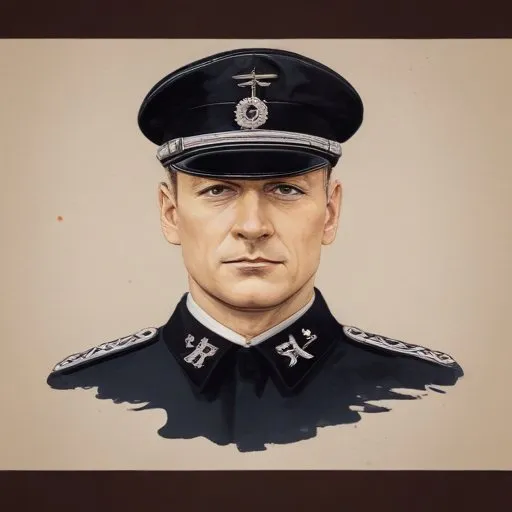
A high-ranking SS officer who played a key role in the Nazi regime's brutal suppression of opposition and implementation of the Holocaust. He was also a leader in the SS Cavalry Brigade, notorious for its atrocities during World War II.
August Heissmeyer is infamously known for his role as the commander of the SS Main Office from 1935 to 1939, and later as the Higher SS and Police Leader of the Berlin-Brandenburg area during World War II. His involvement in the Nazi regime and the atrocities committed during that period have left an indelible mark on history.
Heissmeyer was born on January 11, 1897, in Germany. After finishing school, he joined the Prussian military and later volunteered for the Prussian army during World War I. He served in the 164th Infantry Regiment and was awarded the Iron Cross 1st and 2nd Class for his distinguished service. After the war, he was a member of the Freikorps and participated in the Kapp Putsch.
In 1923, Heissmeyer came into contact with the Nazi Party and officially joined in 1925. He quickly rose through the ranks, becoming responsible for building up the SA-Gausturm Hannover-Sd and serving as the acting Deputy Gauleiter from 1927 to 1928. In 1930, he joined the Schutzstaffel (SS) and was posted to the SS Main Office, becoming its leader in 1935.
Heissmeyer's SS career was marked by his promotion to SS-Obergruppenführer (General) and Inspector of the National Political Institutes of Education in 1936. He was later appointed SS-Oberabschnittsleiter East in 1939 and HSSPF Higher SS and Police Leader Spree in 1940, overseeing the Berlin-Brandenburg area. He took over the command of the SS-Totenkopf Standarte in 1940 from Theodor Eicke.
Heissmeyer's personal life was marked by controversy, including his marriage to Gertrud Scholtz-Klink, the Reichsfrauenführerin (Reich Women's Leader), who had two previous marriages. Heissmeyer had six children from a previous marriage, and his personal relationships have been the subject of much scrutiny.
After World War II, Heissmeyer was tried and convicted as a major Nazi offender. His involvement in the Nazi regime and his role in the atrocities committed during that period have left a lasting legacy of controversy and shame.
August Heissmeyer's legacy serves as a reminder of the dangers of blind obedience and the importance of standing against hate and intolerance. His story serves as a cautionary tale of the devastating consequences of extremism and the importance of promoting peace, unity, and humanity.
Born in 1900
Leading the SS and Gestapo, he oversaw the Nazi regime's brutal security apparatus and implemented the "Final Solution," orchestrating the genocide of six million Jews during World War II.
Born in 1903
Austrian-German lawyer and general who served as the highest-ranking leader of the Nazi police forces, responsible for overseeing the Gestapo, SS, and concentration camps during World War II. He was a key figure in the Holocaust and other atrocities committed by the Nazi regime.
Born in 1904
A high-ranking Nazi official and chief architect of the Holocaust, responsible for implementing the "Final Solution" that led to the murder of six million Jews and millions of others during World War II.
Born in 1896
A high-ranking Waffen-SS officer who played a crucial role in several key battles on the Eastern Front during World War II, known for his military prowess and tactical genius.
Born in 1892
A ruthless and efficient administrator who oversaw the creation and operation of Nazi concentration camps during World War II, responsible for the deaths of millions of people.
Born in 1889
High-ranking SS officer responsible for overseeing the administration of concentration camps during World War II, implementing brutal policies and overseeing mass atrocities.
Born in 1906
A high-ranking Waffen-SS officer and Adolf Hitler's brother-in-law, known for his brutal leadership and close proximity to the Nazi regime's inner circle. He was also a key figure in the final days of WWII, attempting to negotiate a surrender.
Born in 1915
A notorious Waffen-SS commander, infamous for his role in the Malmedy massacre during the Battle of the Bulge, and other war crimes.
