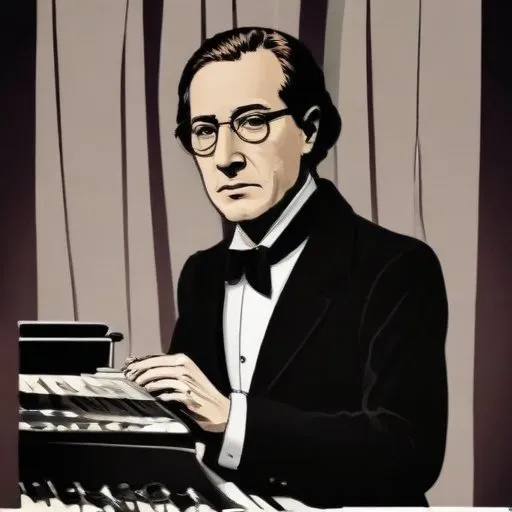
Bedřich Smetana: The Father of Czech Music
A National Icon and Pioneering Composer
Bedřich Smetana is renowned for revolutionizing Czech music, earning him the title "Father of Czech Music." His symphonic cycle, "Má vlast" (My Fatherland), which includes the beloved symphonic poem "Vltava" (The Moldau), is a testament to his profound impact on the country's cultural heritage.
Early Life and Training
Born on March 2, 1824, in Litomyšl, Bohemia (now part of the Czech Republic), Smetana was a child prodigy, giving his first public performance at the tender age of six. He received conventional schooling before pursuing music studies under the guidance of Josef Proksch in Prague.
Nationalistic Beginnings
Smetana's creative journey was marked by his involvement in the 1848 Prague uprising, during which he wrote his first nationalistic music. Although his early career was met with setbacks, he persevered, eventually leaving for Sweden, where he established himself as a teacher and choirmaster in Gothenburg.
Return to Prague and Operatic Success
The liberalized political climate in Bohemia in the early 1860s prompted Smetana's return to Prague, where he became a driving force in the city's musical scene. His first two operas, "The Brandenburgers in Bohemia" and "The Bartered Bride," premiered at the Provisional Theatre in 1866, with the latter achieving immense popularity.
Controversy and Creative Struggles
Smetana's appointment as principal conductor of the Provisional Theatre was marked by controversy, as factions within the musical establishment opposed his advocacy for progressive ideas inspired by
Franz Liszt and
Richard Wagner. These creative struggles took a toll on his health, which began to decline in the following years.
Legacy and Impact
Despite the challenges, Smetana's contributions to Czech music are immeasurable. His work not only reflected the country's cultural aspirations but also paved the way for future generations of Czech composers. Today, he is celebrated as a national icon, and his music remains an integral part of the country's cultural heritage.
Key Works and Compositions
- Operas:
- "The Brandenburgers in Bohemia" (1866)
- "The Bartered Bride" (1866)
- Symphonic Cycle "Má vlast" (My Fatherland):
- "Vltava" (The Moldau)
- "Šárka"
- "From Bohemia's Woods and Fields"
Personal Life and Milestones
- Born: March 2, 1824, in Litomyšl, Bohemia (now part of the Czech Republic)
- Died: May 12, 1884, in Prague, Bohemia (now part of the Czech Republic)
- Married to Karelína Řebíková (married 1849; died 1859)
Trivia and Fun Facts
- Smetana's father, František Smetana, was an amateur musician who encouraged his son's musical talent from an early age.
- During his time in Sweden, Smetana was known for his exceptional skills as a pianist and conductor.
Influence on Modern Society
Smetana's legacy extends beyond the realm of music, as his work embodies the spirit of Czech nationalism and cultural identity. His contributions have inspired generations of artists, musicians, and writers, solidifying his place as a cultural icon in Czech history.
FAQ
What is Bedich Smetanas most famous work?
Bedich Smetanas most famous work is The Bartered Bride, an opera that is considered one of the most important works of Czech opera. The opera is a comedic tale of love, deception, and mistaken identity, and it is still widely performed today.
What was Bedich Smetanas role in the development of Czech opera?
Bedich Smetana played a crucial role in the development of Czech opera, as he was one of the first Czech composers to write operas in the Czech language. This helped to promote Czech culture and identity, and paved the way for future generations of Czech composers.
How did Bedich Smetanas music reflect his Czech heritage?
Bedich Smetanas music reflected his Czech heritage by drawing heavily on Czech folklore and mythology. His operas often explored themes related to Czech culture and history, and he was deeply concerned with promoting Czech identity through his music.
What was Bedich Smetanas contribution to Czech nationalism?
Bedich Smetanas contribution to Czech nationalism was significant, as his music helped to promote Czech culture and identity at a time when the Czech people were seeking independence from Austrian rule.
What was Bedich Smetanas legacy in Czech music?
Bedich Smetanas legacy in Czech music is immense. He is considered one of the most important Czech composers of all time, and his work continues to be widely performed and celebrated today. He also had a significant impact on the development of Czech nationalism, and his music helped to inspire the Czech people to fight for independence.