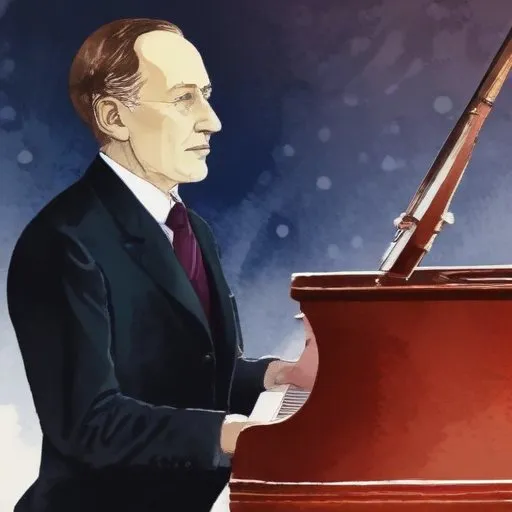
Berthold Goldschmidt: The Suppressed Genius of 20th-Century Music
The Forgotten Master of Lyricism
Berthold Goldschmidt was a renowned German-Jewish composer who defied the musical norms of his time, only to be silenced by the Nazi regime and later rediscovered in his final years. He is best known for his unique blend of lyricism and modernism, which earned him both critical acclaim and vociferous dismissal.
Early Life and Training
Born in Hamburg, Germany on January 18, 1903, Goldschmidt's musical journey began during the Weimar Republic's heyday. While studying philosophy at the University of Hamburg, he was encouraged by
Ferruccio Busoni to pursue music. In 1922, Goldschmidt enrolled in the Berlin Hochschule für Musik, where he joined
Franz Schreker's composition class alongside fellow pupils
Ernst Krenek,
Alois Hába, Felix Petyrek, and Jascha Horenstein.
Rise to Prominence
Goldschmidt's breakthrough came in 1925 with his Passacaglia, Op. 4, which earned him the prestigious Mendelssohn Prize. Hailed as one of the most promising young composers of his generation, Goldschmidt reached the pinnacle of his career with the premiere of his opera
Der gewaltige Hahnrei in Mannheim in 1932.
The Suppression of Genius
However, this triumph was short-lived, as the Nazi takeover of Germany soon destroyed Goldschmidt's livelihood. His work was condemned as "degenerate music" by the regime, and performances of his compositions were banned. Goldschmidt was forced to earn a living by giving piano lessons, until an SS officer advised him to leave the country. In 1935, he emigrated to England, where he struggled to regain his footing in the musical world.
Rediscovery and Legacy
It wasn't until the 1980s, when Goldschmidt was in his 80s, that his music experienced a long-overdue revival. Conductors and musicians began to recognize the unique lyricism and craftsmanship that had been suppressed for so long. Today, Goldschmidt's works are hailed as a testament to the power of art to transcend even the darkest of times.
Major Works
- Der gewaltige Hahnrei (1932) - Opera
- Passacaglia, Op. 4 (1925) - Orchestral work
- Symphony, Op. 16 (1936) - Orchestral work
- The Magnificat (1949) - Choral work
Influence on Modern Society
Goldschmidt's story serves as a powerful reminder of the destructive power of censorship and the importance of preserving artistic freedom. His music, once silenced by the Nazi regime, now resonates with audiences worldwide, a testament to the enduring power of creativity and resilience.
Personal Milestones
- 1925: Awarded the Mendelssohn Prize for his Passacaglia, Op. 4
- 1932: Premiere of his opera Der gewaltige Hahnrei in Mannheim
- 1935: Emigrated to England to escape Nazi persecution
- 1980s: Experienced a revival of his music, leading to widespread recognition
Historical Context and Legacy
Berthold Goldschmidt's life and work serve as a poignant reminder of the devastating impact of the Nazi regime on the lives of Jewish artists and intellectuals. His unique blend of lyricism and modernism has inspired generations of composers, and his story continues to inspire and educate audiences today.
FAQ
What is Berthold Goldschmidts most famous composition?
Berthold Goldschmidts most famous composition is his opera Beatrice Cenci, which premiered in 1951. This opera showcases his unique blend of modernist and romantic styles, earning him critical acclaim and recognition as a prominent composer.
What style of music did Berthold Goldschmidt primarily compose?
Berthold Goldschmidt primarily composed modern classical music, often incorporating elements of romanticism and expressionism. His style is characterized by complex harmonies and a focus on dramatic intensity.
What was Berthold Goldschmidts role in the development of modern classical music?
Berthold Goldschmidt played a significant role in the development of modern classical music, contributing to the evolution of the genre through his innovative compositions and collaborations with other prominent composers.
How did Berthold Goldschmidts background influence his music?
Berthold Goldschmidts background as a German Jew had a profound impact on his music. His experiences during World War II and the Holocaust influenced his work, often incorporating themes of struggle, loss, and hope.
What awards did Berthold Goldschmidt receive for his compositions?
Berthold Goldschmidt received several awards for his compositions, including the Hindemith Prize and the City of Vienna Prize. These awards recognize his significant contributions to modern classical music and his innovative compositional style.