


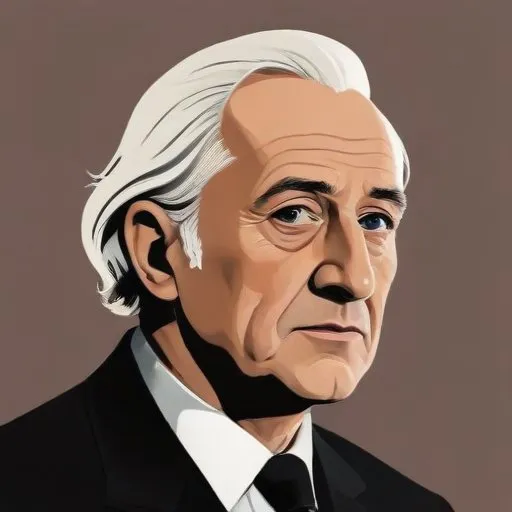
A German composer and playwright who blended jazz and classical music to create innovative operas and ballets, known for his unique fusion of styles and genres.
Boris Blacher was a renowned German composer and librettist, known for his contributions to the world of music, particularly in the realms of opera and chamber music. His compositions, marked by a unique blend of modernity and lyricism, have left an indelible mark on the classical music landscape.
Born on January 6, 1903, in Niuzhuang, Manchuria, to a family of German-Estonian and Russian descent, Blacher spent his early years in China and Russia. In 1919, he moved to Harbin, and later, in 1922, to Berlin, where he began to study architecture, mathematics, and music at the Berlin Hochschule fuer Musik.
Blacher's early career was marked by arranging popular and film music, but it was his composition studies with Friedrich Koch that truly propelled him towards greatness. Unfortunately, his career was interrupted by the National Socialist regime, which deemed his music "degenerate" and stripped him of his teaching post at the Dresden Conservatory.
After World War II, Blacher's career resumed, and he went on to become a driving force in the music world. He became president of the Academy of Arts, Berlin, and was instrumental in shaping the musical landscape of post-war Germany. His students, including Aribert Reimann, Isang Yun, and Maki Ishii, would go on to become renowned composers in their own right.
Blacher wrote the librettos for Gottfried von Einem's operas Dantons Tod (1947) and Der Proze (1953), cementing his reputation as a master librettist. His own compositions, including symphonies, chamber music, and choral works, continue to be performed and admired today.
Blacher was married to the pianist Gerty Blacher-Herzog, and they had four children, including the German actress Tatjana Blacher and the international violinist Kolja Blacher. He passed away on January 30, 1975, in Berlin, at the age of 72, leaving behind a legacy that continues to inspire generations of musicians.
Boris Blacher's contributions to the world of music are immeasurable. As a composer, librettist, and educator, he left an indelible mark on the classical music landscape. His students, colleagues, and admirers continue to celebrate his life's work, ensuring that his legacy endures for generations to come.
Blacher was buried in an Ehrengrab in the Waldfriedhof Zehlendorf, Berlin, a testament to his stature as a musical icon. Today, his music continues to inspire, educate, and uplift, a fitting tribute to a life dedicated to the pursuit of artistic excellence.
Born in 1895
A renowned composer, violist, and conductor who blended traditional and modern styles, creating complex yet accessible music that resonated with audiences. His works spanned from operas to chamber music.
Born in 1900
A renowned pianist and composer who blended jazz and classical music to create iconic scores for Broadway and opera, including "The Threepenny Opera" and "Mahagonny".
Born in 1892
A French composer and educator who blended jazz and classical music to create a unique sound, and is best known for his ballet scores and chamber music compositions.
Born in 1878
Austrian composer and conductor of early 20th-century operas and symphonies, known for his bold, expressive, and innovative style that blended late Romanticism with early Modernism. His works are still performed today, offering a glimpse into a bygone era.
Born in 1900
Austrian-American composer and educator who blended jazz and classical music, creating innovative operas and symphonies. Known for his eclectic style and influential teaching methods.
Born in 1898
A German-Austrian soldier and composer who wrote music for films, theater, and concert halls, and is best known for his collaborations with Bertolt Brecht and his influence on 20th-century classical music.
Born in 1905
A German composer who blended modernist and neoclassical styles, creating symphonies and chamber music that explored the human condition.
Born in 1918
Austrian pianist and composer renowned for his operas and ballets, blending modernist and neoclassical styles, with works like "The Visit of the Old Lady" and "Dantons Tod".
