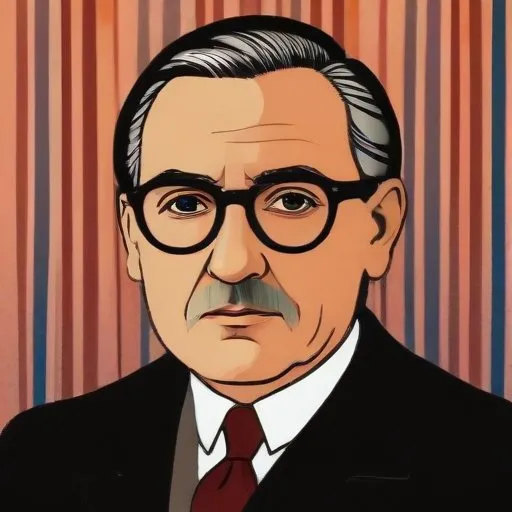
Bruno Frank: The Renowned German Author and Humanist
A Life of Literary Excellence and Persecution
Bruno Frank was a German author, poet, playwright, and screenwriter, best known for his contributions to German Exilliteratur, a genre of literature written by anti-Nazi writers who fled Nazi Germany. His works include novels, plays, and screenplays, showcasing his versatility and talent in the literary world.
Early Life and Education
Frank was born on June 13, 1887, in Stuttgart, Germany. He studied law and philosophy in Munich, where he later worked as a dramatist and novelist. His early life was marked by a passion for literature and the arts, which would later become the foundation of his successful career.
The Road to Exile
Following the Reichstag fire in 1933, Frank was persecuted by the Nazi government due to his Jewish heritage. He was forced to leave Germany with his wife, Liesl, and daughter of the famous Jewish operetta diva Fritzi Massary and Count Karl Coudenhove. The family lived in Austria and England for four years before emigrating to the United States in 1937.
A New Life in Hollywood
In the United States, Frank was reunited with his friends
Heinrich Mann and
Thomas Mann, also prominent German writers. He continued to write, producing two novels, and worked in the film industry for the rest of his life. One of his most notable works during this period was the screenplay for the 1939 film adaptation of
Victor Hugo's
The Hunchback of Notre Dame, directed by William Dieterle and starring Charles Laughton.
Notable Works
- The Days of the King (1924) - novel
- Trenck (1924) - novel
- Twelve Thousand (1927) - play
- Storm Over Patsy (1930) - comic play
- A Man Called Cervantes (1934) - historical novel
- The Magician and Other Stories (1947) - short story collection
- One Fair Daughter (1943) - novel
Filmography
- Different Morals (1931) - directed by Gerhard Lamprecht, based on the play Perlenkomödie
- Storm in a Water Glass (1931) - directed by Georg Jacoby, based on the play Sturm im Wasserglas
- Storm in a Teacup (1937) - filmed in Great Britain, based on the play Sturm im Wasserglas
Legacy and Impact
Bruno Frank's contributions to literature and the film industry have left a lasting impact on modern society. His works continue to be celebrated for their depth, complexity, and humanitarian themes. As a member of the German Exilliteratur movement, Frank's writing served as a powerful voice against Nazi oppression and persecution.
Personal Life and Milestones
Frank died on June 20, 1945, of a heart attack in Beverly Hills, California. He is interred in the Forest Lawn Memorial Park Cemetery in Glendale, California. His nephew, Anthony M. Frank, went on to become the United States Postmaster General in 1988.
Bruno Frank's life was marked by both literary excellence and personal hardship. Despite the challenges he faced, he continued to write, creating a body of work that remains an integral part of German literary history.
FAQ
What was Bruno Franks most notable work in literature?
Bruno Frank was a German-American author who wrote several notable works of fiction and non-fiction, including The Days of the King and The Redeemer.
Did Bruno Frank only work as a writer or did he have other pursuits?
Bruno Frank was a writer, poet, and playwright who also had a passion for music and art. He was known for his cultural and intellectual pursuits.
What was Bruno Franks early life like?
Bruno Frank was born on June 13, 1887, in Stuttgart, Germany. He studied literature and philosophy at the University of Stuttgart and later worked as a writer and journalist.
How did Bruno Franks experiences as a German-American influence his writing?
Bruno Franks experiences as a German-American informed his writing, particularly in his explorations of identity, culture, and politics. He was known for his nuanced and introspective prose.
What is Bruno Franks legacy in German-American literature?
Bruno Frank is remembered as a significant figure in German-American literature, known for his contributions to the countrys literary heritage and his exploration of the German-American experience.