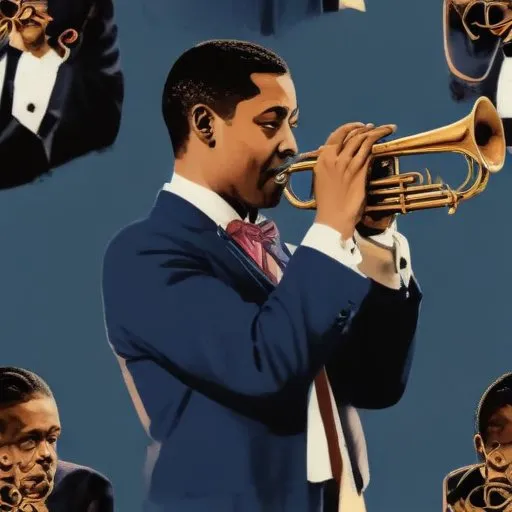
Buck Clayton: The Trumpet Maestro of Jazz
A Legendary Career Born from Inspiration
Buck Clayton, an American jazz trumpeter, is renowned for his soulful melodies and virtuosic technique, which earned him a coveted spot in
Count Basie's orchestra. As a protégé of the legendary
Louis Armstrong, Clayton's distinctive style was shaped by the jazz greats, leaving an indelible mark on the genre.
Early Years and Influences
Born Wilbur Dorsey Clayton on November 12, 1911, the young musician began his journey with piano lessons at the age of six. His father, an amateur musician, introduced him to the trumpet, teaching him the scales and sparking a lifelong passion. Clayton's early influences included Louis Armstrong, whose record "Confessin' That I Love You" became a defining moment in his life. He would later receive guidance from trumpeters Mutt Carey and
Bob Russell, further refining his craft.
Rise to Prominence
In his early twenties, Clayton relocated to California, where he briefly joined
Duke Ellington's Orchestra and worked with other prominent leaders. It was during this period that he met Louis Armstrong, who taught him the art of glissando on the trumpet. This encounter had a profound impact on Clayton's playing style, which would eventually become a hallmark of his performances.
The Shanghai Interlude
In the mid-1930s, Clayton embarked on a journey to Shanghai, China, where he led the Harlem Gentlemen orchestra at the prestigious Canidrome ballroom. This period was marked by collaborations with Chinese musicians, including Li Jinhui, with whom he incorporated traditional Chinese scales into American jazz. Clayton's time in Shanghai fostered a unique cultural exchange, leaving a lasting impact on the city's jazz scene.
Career Highlights and Major Works
- Leader of the Harlem Gentlemen orchestra in Shanghai (1934-1935)
- Member of Count Basie's orchestra (1930s-1940s)
- Collaborations with Duke Ellington, Louis Armstrong, and other jazz luminaries
- Recordings with labels such as Columbia, Victor, and Decca
Philosophical Contributions and Beliefs
Buck Clayton's approach to jazz was rooted in a deep respect for tradition and a passion for innovation. He believed that music should be a universal language, capable of transcending cultural boundaries. This philosophy is reflected in his eclectic style, which seamlessly blended American jazz with international influences.
Legacy and Impact
Buck Clayton's contributions to jazz are undeniable. He played a crucial role in shaping the genre, inspiring generations of musicians, and fostering cultural exchange through his music. As a testament to his legacy, Clayton's music continues to captivate audiences, ensuring his place among the jazz greats.
Inspirational Quotes
- "Music is a universal language that can bring people together, no matter their background or culture."
- "The beauty of jazz lies in its ability to evolve, to adapt to new influences and styles."
Awards and Honors
- Inducted into the Jazz Hall of Fame (1987)
- Recipient of the NEA Jazz Masters Fellowship (1988)
Personal Milestones and Key Life Events
- Born on November 12, 1911, in Parsons, Kansas
- Died on December 8, 1991, in New York City
- Moved to Los Angeles in the early 1930s, where he began his professional career
Buck Clayton's remarkable life and career serve as a testament to the power of music to bring people together, to inspire, and to transcend boundaries. His legacy continues to inspire generations of musicians, ensuring his place as one of the most influential jazz trumpeters of all time.
FAQ
What are Buck Claytons notable jazz performances?
Buck Clayton was an American trumpet player and academic, and his notable jazz performances include playing with Count Basies Orchestra and performing at the 1957 Jazz at the Philharmonic concert.
What was Buck Claytons role in the Count Basie Orchestra?
Buck Clayton played trumpet in the Count Basie Orchestra from 1936 to 1943, contributing to the orchestras distinctive sound and style.
How did Buck Clayton influence jazz education?
Buck Clayton was a pioneering jazz educator, teaching at colleges and universities and helping to establish jazz studies programs.
What are Buck Claytons notable compositions and arrangements?
Buck Clayton was a prolific composer and arranger, creating works for jazz ensembles and big bands, including arrangements for the Count Basie Orchestra.
What is Buck Claytons legacy in American jazz?
Buck Claytons legacy in American jazz is marked by his virtuosic trumpet playing, his contributions to the Count Basie Orchestra, and his pioneering work in jazz education.