


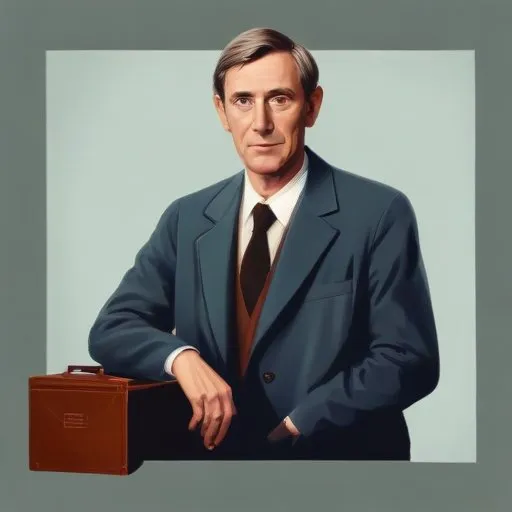
Developed the theory of emergent evolution, which proposes that complex systems exhibit novel properties that cannot be predicted from their individual parts. Known for his work on comparative psychology and animal behavior.
C. Lloyd Morgan, a renowned British ethologist and psychologist, is best known for his groundbreaking theory of emergent evolution and the development of Morgan's Canon, a principle that revolutionized the field of animal psychology and behaviorism. This innovative thinker left an indelible mark on the scientific community, shaping the way we understand the intricate relationships between intelligence, instinct, and evolution.
Born on February 6, 1852, in London, Morgan's fascination with the natural world began at a young age. He pursued his passion for geology and zoology, studying at the Royal School of Mines and later under the tutelage of T. H. Huxley. This foundational education laid the groundwork for his future contributions to the field of ethology.
In 1884, Morgan joined the staff of University College, Bristol, as Professor of Geology and Zoology. This marked the beginning of his illustrious academic career, during which he conducted research on local geological and zoological phenomena. However, it was his interest in the borderland between intelligence and instinct that eventually led him to focus on the field of mental evolution.
In 1901, Morgan became the college's first Professor of Psychology and Education, where he developed and refined his theory of emergent evolution. This concept posits that evolution is a gradual process, marked by the emergence of new and complex traits from simpler, pre-existing ones. Morgan's work in this area had far-reaching implications, influencing the development of behaviorism and shaping the course of modern psychology.
Morgan's Canon, a principle that stipulates that higher mental faculties should only be considered as explanations if lower faculties cannot explain a behavior, became a cornerstone of animal psychology and behaviorism. This canon has had a profound impact on our understanding of animal cognition, encouraging researchers to adopt a more nuanced and empirical approach to studying animal behavior.
Morgan's contributions to the scientific community were recognized through various awards and honors. He was elected a Fellow of the Royal Society in 1899 and delivered the prestigious Croonian Lecture in 1901. In 1909, he became the first Vice-Chancellor of the University of Bristol, playing a pivotal role in securing the institution's full university status.
Following his retirement, Morgan delivered a series of influential Gifford Lectures at St. Andrews, further solidifying his legacy in the field of ethology. Today, his work remains a testament to his innovative spirit and continues to inspire new generations of researchers and scientists.
Morgan's theory of emergent evolution has had a profound impact on our understanding of the natural world, influencing fields beyond psychology and ethology. His work has inspired novelists, philosophers, and scientists alike, shaping the way we think about evolution, intelligence, and the human condition.
In popular culture, Morgan's ideas have been referenced in films, literature, and art, demonstrating the far-reaching influence of his groundbreaking work. As a pioneer in the field of ethology, Morgan's legacy continues to inspire and inform new areas of research, ensuring his work remains relevant and vital in modern society.
Through his remarkable contributions to the fields of ethology, psychology, and education, C. Lloyd Morgan has left an indelible mark on our understanding of the natural world and human experience. As we continue to explore the complexities of evolution, intelligence, and behavior, we stand on the shoulders of this pioneering thinker, who dared to challenge conventional wisdom and push the boundaries of human knowledge.
Born in 1809
Developed the theory of evolution through natural selection, revolutionizing our understanding of life on Earth. This groundbreaking idea transformed the fields of biology, ecology, and beyond.
Born in 1823
A pioneering naturalist who discovered evolution through natural selection, independently of Charles Darwin, and contributed significantly to the field of biogeography.
Born in 1822
Pioneering the concept of correlation and regression analysis, this statistician is renowned for developing the field of biostatistics and introducing the idea of inherited intelligence.
Born in 1825
A British explorer who traveled to the Amazon rainforest and discovered over 8,000 species, including butterflies, beetles, and birds, and is known for his theory of mimicry in nature.
Born in 1838
Discovered the first synthetic dye, mauveine, and pioneered the development of synthetic dyes, revolutionizing the textile industry. His work had a significant impact on fashion, art, and industry.
Born in 1820
A pioneering physicist who made significant contributions to the discovery of the greenhouse effect and the behavior of gases, and an accomplished mountaineer who conquered several Alpine peaks.
Born in 1825
A prominent figure in the scientific community, known for advocating Charles Darwin's theory of evolution and coining the term "agnostic" to describe his own religious views.
