


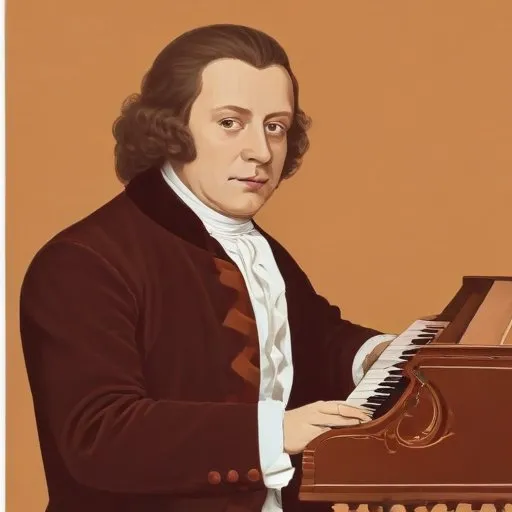
A renowned harpsichord virtuoso and composer of the late Baroque period, known for his innovative and expressive works that bridged the gap between Baroque and Classical styles.
Carl Friedrich Christian Fasch was a renowned German composer and harpsichordist, best known for founding the prestigious SingAkademie in Berlin and promoting the music of J.S. Bach and other Baroque masters. Through his contributions to music, Fasch left an indelible mark on the late 18th century musical landscape.
Born in 1736 in Zerbst, Germany, Fasch was the son of composer Johann Friedrich Fasch. He received his initial training from his father, followed by studies in Coethen and Strelitz, where he honed his skills in harmony, accompaniment, and composition under the guidance of Hertel.
In 1756, Fasch began his service at the court of Frederick the Great of Prussia, initially as a deputy to Court harpsichordist C.P.E. Bach. When Bach left for Hamburg in 1767, Fasch succeeded him as the court harpsichordist. This position allowed him to refine his skills and compose numerous works, including his famous Mass for sixteen voices, a virtuosic piece accompanied solely by organ continuo.
In 1791, Fasch founded the SingAkademie in Berlin, which quickly became a hub of musical activity in the city. Through the Akademie, Fasch promoted the music of J.S. Bach, Handel, and other Baroque masters, as well as contemporary compositions. The institution attracted notable visitors, including Beethoven in 1796, and served as a platform for Fasch to showcase his own compositions.
Fasch's contributions to music extend beyond his compositions and founding of the SingAkademie. He played a significant role in preserving and promoting the music of the Baroque period, paving the way for future generations of composers and musicians. His legacy continues to inspire and influence musicians to this day.
Fasch's legacy extends beyond the realm of classical music. His contributions to the preservation and promotion of Baroque music have had a lasting impact on Western classical music, influencing composers and musicians across various genres.
Today, the SingAkademie remains an important cultural institution in Berlin, continuing to promote musical excellence and preserve the legacy of Carl Friedrich Christian Fasch.
Born in 1714
A renowned 18th-century musician, he was a prolific composer and virtuosic performer, known for his expressive and innovative keyboard music that bridged the Baroque and Classical styles. His compositions, particularly for harpsichord and piano, showcased his mastery of counterpoint and harmony.
Born in 1685
A renowned Baroque composer and organist, famous for creating majestic orchestral suites, operas, and oratorios, including the iconic "Messiah" masterpiece.
Born in 1685
A master of Baroque music, he composed over 1,000 works, including orchestral suites, cantatas, and passions, that still inspire and influence musicians today. His innovative use of counterpoint and harmony raised the bar for classical music.
Born in 1685
A virtuosic harpsichordist and composer, renowned for crafting over 550 sonatas that showcased his innovative and expressive style, blending Italian and Portuguese influences. 42
Born in 1782
A virtuosic violinist and composer who revolutionized the instrument's technical possibilities, leaving an indelible mark on classical music.
Born in 1770
A musical genius who expanded the possibilities of classical music, creating iconic symphonies and piano sonatas that continue to inspire and influence generations of artists.
Born in 1756
A child prodigy and master of classical music, he composed over 600 works, including symphonies, operas, and chamber music, that continue to inspire and influence musicians today.
Born in 1714
A pioneering opera composer who revolutionized the art form with his innovative and expressive works, blending music and drama in a way that captivated audiences.
