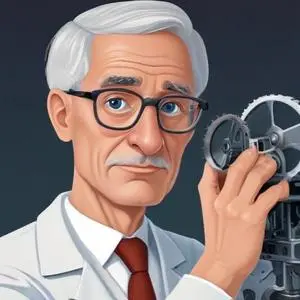
Carl Zeiss: The Master Optician Who Revolutionized the World of Scientific Instruments
A Legacy of Precision and Innovation
Carl Zeiss, a German scientific instrument maker, optician, and businessman, is renowned for founding the esteemed Carl Zeiss AG, a company that has been at the forefront of optical instrument production for over 175 years. His groundbreaking collaboration with
Ernst Abbe and Otto Schott transformed the landscape of optical theory, microscope design, and optical glass manufacture, cementing Zeiss's position as a pioneer in his field.
Early Life and Family
Born on September 11, 1816, in Weimar, Germany, Carl Zeiss was the fifth of six surviving children to Johann Gottfried August Zeiss, a skilled ornamental turner, and Johanna Antoinette Friederike Schmith. His family's roots were deeply entrenched in artisanal traditions, with his forefathers working as craftsmen for over a century. An interesting connection to the world of literature is that Zeiss's mother was related to
Christiane Vulpius, the spouse of the famed German writer
Johann Wolfgang von Goethe.
A Passion for Precision: Early Years and Education
Growing up in a household where craftsmanship was valued, Zeiss developed an early fascination with precision and mechanics. He pursued his passion by training as a mechanic in the workshop of Friedrich Körner, a prominent precision mechanic in Weimar. This experience laid the foundation for his future successes as an optician and instrument maker.
Founding of Carl Zeiss AG and Revolutionary Collaborations
In 1846, Zeiss established his workshop, which would eventually become the illustrious Carl Zeiss AG. He gathered a talented group of practical and theoretical opticians and glass makers, including Ernst Abbe, a brilliant physicist and mathematician, and Otto Schott, a pioneering glass maker. Their collaborative efforts led to a paradigm shift in optical instrument production, as they revolutionized microscope design, optical theory, and glass manufacture.
Major Contributions and Innovations
- Microscope Design: Zeiss's collaboration with Abbe led to the development of the first high-quality microscope, which featured a condenser lens system and revolutionized the field of microscopy.
- Optical Glass Manufacture: The partnership with Schott enabled the production of high-quality optical glass, paving the way for the development of new optical instruments.
- Optical Theory: Zeiss and Abbe's work on optical theory laid the foundation for modern optics, enabling the creation of more sophisticated optical instruments.
Legacy and Impact
Today, Carl Zeiss AG is one of the largest and most respected optical firms in the world, with a reputation for excellence in precision optics, microscopy, and other fields. Zeiss's contributions have had a profound impact on various disciplines, including biology, medicine, materials science, and astronomy. His commitment to precision, innovation, and collaboration has inspired generations of scientists, engineers, and instrument makers.
Awards and Recognition
Throughout his lifetime, Zeiss received numerous accolades for his contributions to science and industry, including the Grand Ducal Medal of Honor and the Golden Imperial Medal ofMerit.
Personal Milestones and Key Life Events
- 1846: Founded his workshop, which would eventually become Carl Zeiss AG.
- 1866: Collaborated with Ernst Abbe, marking the beginning of a transformative partnership.
- 1870s: Established a close working relationship with Otto Schott, leading to significant advancements in optical glass manufacture.
- 1888: Passed away on December 3, leaving behind a legacy of innovation and precision.
Carl Zeiss's remarkable journey, marked by his relentless pursuit of precision and innovation, has left an indelible mark on the world of scientific instruments. His pioneering spirit, collaborative approach, and commitment to excellence continue to inspire generations of scientists, engineers, and instrument makers.
FAQ
What were Carl Zeisss contributions to optics?
Carl Zeiss was a German lens maker who made significant contributions to the field of optics. He developed new techniques for grinding and polishing lenses, and introduced the first high-quality microscope lenses.
How did Carl Zeisss innovations impact the field of microscopy?
Carl Zeisss innovations had a profound impact on the field of microscopy. His high-quality microscope lenses enabled scientists to study microorganisms and cells in greater detail, leading to major breakthroughs in fields such as biology and medicine.
What was Carl Zeisss role in the development of modern optics?
Carl Zeiss played a key role in the development of modern optics. He founded the Carl Zeiss AG company, which became a leading manufacturer of optical instruments, and continued to innovate and improve lens design throughout his career.
How did Carl Zeisss company impact the development of modern technology?
Carl Zeisss company had a significant impact on the development of modern technology. The companys optical instruments were used in a wide range of fields, including astronomy, medicine, and industrial manufacturing, and helped to drive innovation and progress in these areas.
What was Carl Zeisss legacy in the field of optics?
Carl Zeisss legacy in the field of optics is one of innovation, quality, and precision. He is remembered as a pioneer in the development of modern optics, and his company continues to be a leading manufacturer of optical instruments to this day.