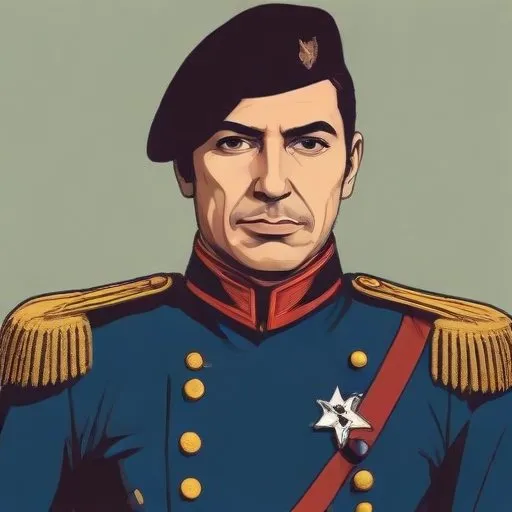
Carlos Mara de Alvear: The Argentine Statesman and Soldier
A Leader in the Argentine War of Independence
Carlos Mara de Alvear is best known for his role as the Supreme Director of the United Provinces of the Río de la Plata in 1815, a pivotal position that shaped the course of Argentine history. As a skilled military officer and statesman, Alvear played a crucial part in the Argentine War of Independence, fighting for the country's liberation from Spanish rule.
Early Life and Education
Born on October 25, 1789, in Santo Ângel, Rio Grande do Sul (now in Brazil), Alvear was the son of a Spanish nobleman, Diego de Alvear y Ponce de León, and a criolla mother, María Balbastro. His early life took a dramatic turn in 1804 when a Royal Navy fleet attacked the Spanish Navy squadron on which he was traveling with his family. Although his brothers and mother were killed in the battle, Alvear survived and was taken as a prisoner of war by the British, along with his father, to England.
During his stay in Britain, the 15-year-old Alvear received an English-style education, which would later influence his views and policies as a statesman. It was also during this time that he adopted the name Carlos Mara de Alvear in honor of his mother.
Military Career and Freemasonry
Alvear's military career was marked by his service in the Spanish Army during the Napoleonic Wars. He was one of the few professional military officers to join the Argentine War of Independence on the side of the revolutionaries. Like many other prominent Argentines of his time, Alvear was a Freemason. In fact, he founded the Sociedad de los Caballeros Racionales, a Masonic secret society, in Cadiz, Spain.
Supreme Director of the United Provinces
In 1815, Alvear assumed the position of Supreme Director of the United Provinces of the Río de la Plata, becoming one of the most influential leaders of the Argentine War of Independence. During his tenure, he worked closely with
José de San Martín, another prominent figure of the revolution.
Legacy and Controversies
Alvear's legacy is complex and multifaceted. While he played a crucial role in Argentina's struggle for independence, some critics have accused him of being too accommodating to British interests, given his English education and Masonic connections. Nevertheless, his contributions to Argentine history are undeniable, and he remains an important figure in the country's fight for independence.
Personal Life and Milestones
Alvear married an Irish woman during his stay in Britain and had several children. He died on November 3, 1852, in New York.
Timeline of Key Events
- 1789: Born in Santo Ângel, Rio Grande do Sul
- 1804: Captured as a prisoner of war by the British and taken to England
- 1815: Became Supreme Director of the United Provinces of the Río de la Plata
- 1852: Died in New York
Quotes and Memorable Sayings
Although there are no recorded quotes from Alvear, his legacy and actions speak to his commitment to Argentine independence and self-determination.
By examining Alvear's life and career, we gain insight into the complexities of Argentine history and the role of key figures in shaping the country's destiny.
FAQ
What was Carlos María de Alvears role in the Argentine War of Independence?
Carlos María de Alvear played a key role in the Argentine War of Independence, serving as a cavalry officer and later as the president of the Tucumán Congress.
What were Carlos María de Alvears accomplishements as a statesman?
As a statesman, Alvear served as the first Supreme Director of the United Provinces of Rio de la Plata, implementing important reforms and modernizing the countrys infrastructure.
Where did Carlos María de Alvear receive his military training?
Alvear received his military training in Spain, where he fought in the Spanish War of Independence against Napoleons forces.
What was Carlos María de Alvears relationship with José de San Martín?
Alvear and José de San Martín were close allies, working together to secure Argentine independence and later falling out over political differences.
What was Carlos María de Alvears legacy in Argentine history?
Alvears legacy in Argentine history is that of a hero and a pioneer, instrumental in shaping the countrys early years and laying the foundations for its future growth.