


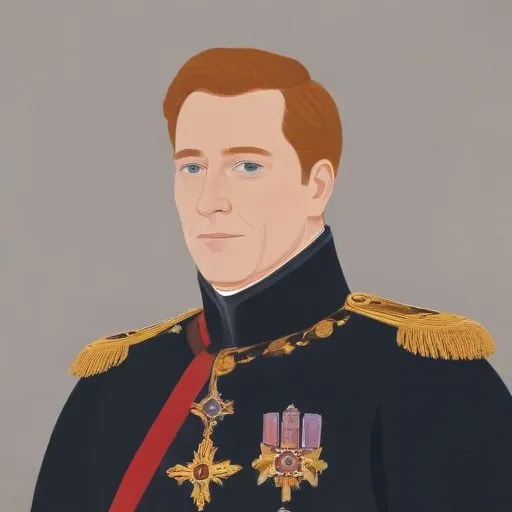
A 16th-century French nobleman who ruled Lorraine and was a key player in the Wars of Religion, known for his diplomatic efforts to maintain independence from France.
Charles III, Duke of Lorraine, also known as the Great, is renowned for his wise leadership, shrewd diplomacy, and cultural patronage during his reign from 1545 to 1608. He is celebrated for maintaining peace and prosperity in Lorraine, a feat that earned him the respect of his contemporaries and the admiration of posterity.
Born on February 18, 1543, Charles III was the eldest surviving son of Francis I, Duke of Lorraine, and Christina of Denmark. Following his father's death in 1545, his mother served as regent during his minority. During this period, his great-grandmother, Philippa of Gelderland, died in 1547, leaving Charles a substantial inheritance.
In 1552, Lorraine was invaded by France, and Charles was removed from his duchy to be raised at the French royal court. This move was orchestrated to ensure French interests were secured in Lorraine. Charles was eventually allowed to return to his domain in 1559, after marrying Claude of France, and assuming control of his duchy.
The reign of Charles III is often referred to as a golden age of peace and prosperity for Lorraine. He skillfully navigated the complex web of alliances and rivalries between France and the Holy Roman Empire, maintaining a policy of neutrality during the French Wars of Religion. This pragmatic approach earned him the respect of his contemporaries and ensured Lorraine remained a haven of stability in a tumultuous era.
Charles III was a generous patron of the arts and education. He founded the University of Pont-à-Mousson, which became a beacon of learning and culture in the region. He also supported the arts, commissioning elaborate pageants and festivities, such as the famous masque involving pageant ships with silver cloth sails, designed by Bartolomeo Campi, at the wedding of Mary, Queen of Scots, and Francis, Dauphin of France.
Charles III expanded his realm through strategic alliances and negotiations. In 1590, he acquired Pfalzburg from George John I, Count Palatine of Veldenz, and attempted to conquer Ltzelstein, although a truce was eventually negotiated. He broke his policy of neutrality in 1589, allying himself with the French Catholic League to counter the rising influence of Henry of Navarre.
Charles III, Duke of Lorraine, left an indelible mark on European history. His wise leadership, cultural patronage, and shrewd diplomacy ensured Lorraine remained a beacon of peace and prosperity during a tumultuous era. His reign serves as a testament to the power of visionary leadership and the importance of maintaining a balance of power in international relations.
Born in 1677
The last king of Poland before the country's partitions, he's known for his diplomatic skills and attempts to reform the Polish-Lithuanian Commonwealth. He's also famous for being the father-in-law of Louis XV of France.
Born in 1710
The monarch who ruled France from 1715 to 1774, known as the "Sun King's" great-grandson, and remembered for his extravagance, absolutism, and the decline of the French monarchy.
Born in 1500
Ruling over a vast empire from 1519 to 1556, he was a powerful and influential leader who played a crucial role in shaping European politics and religion. He is most known for his efforts to unify Christian Europe and defend it against the Ottoman Empire.
Born in 1768
The last Holy Roman Emperor, who ruled from 1792 to 1806, oversaw the dissolution of the Holy Roman Empire and was a key figure in European politics during the Napoleonic Wars.
Born in 1747
The last Habsburg ruler to hold the title of Holy Roman Emperor, he oversaw the dissolution of the empire and played a key role in European politics during the French Revolution.
Born in 1741
Reformer of the Habsburg dominions, abolishing serfdom and promoting religious tolerance, who implemented numerous reforms to modernize his empire.
Born in 1500
Ruling over a vast empire from 1519 to 1556, he was a powerful and influential leader who played a crucial role in shaping European politics and religion. He is most known for his efforts to unify Christian Europe and defend it against the Ottoman Empire.
