


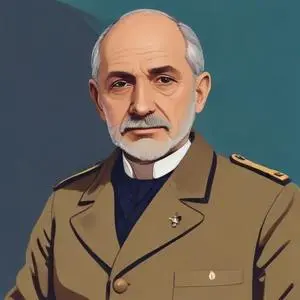
French physician and parasitologist who discovered the parasites that cause malaria and other diseases, earning a Nobel Prize in Physiology or Medicine in 1907.
Charles Louis Alphonse Laveran, a French physician, made groundbreaking discoveries that revolutionized our understanding of infectious diseases, earning him the Nobel Prize in Physiology or Medicine in 1907. His pioneering work on parasitic protozoans as causative agents of diseases such as malaria and trypanosomiasis forever changed the landscape of medicine.
Born on June 18, 1845, in Paris, France, Laveran was the only son of Louis Théodore Laveran, an army doctor and professor of military medicine, and Marie-Louise Anselme Gunard de la Tour Laveran. Growing up in a military environment, Laveran was exposed to the world of medicine from an early age. He pursued his medical degree at the University of Strasbourg, graduating in 1867.
Following in his father's footsteps, Laveran joined the French Army during the Franco-Prussian War in 1870. This experience laid the foundation for his future work in military medicine and epidemics. At the age of 29, he became Chair of Military Diseases and Epidemics at the École de Val-de-Grâce.
In 1878, Laveran's work took him to Algeria, where he made his most significant contributions to the field of medicine. Through his research, he discovered that the protozoan parasite Plasmodium was responsible for malaria, and that Trypanosoma caused trypanosomiasis, also known as African sleeping sickness. These breakthroughs paved the way for further research into the causes and treatment of infectious diseases.
In 1894, Laveran returned to France, where he joined the Pasteur Institute as Chief of the Honorary Service. It was during this period that he was awarded the Nobel Prize in Physiology or Medicine in 1907. In a gesture of philanthropy, Laveran donated half of his Nobel Prize money to establish the Laboratory of Tropical Medicine at the Pasteur Institute.
In 1908, Laveran founded the Société de Pathologie Exotique, a society dedicated to the study of tropical diseases. This organization played a vital role in advancing research and collaboration in the field of tropical medicine.
Laveran's discoveries and contributions to the field of medicine have had a profound impact on our understanding of infectious diseases. His work paved the way for further research into the causes and treatment of diseases such as malaria and trypanosomiasis. Today, his legacy continues to inspire scientists and researchers around the world.
Through his tireless efforts, Laveran has left an indelible mark on the history of medicine, and his name remains synonymous with pioneering research in the field of protozoan diseases.
Born in 1822
Developed vaccines for rabies and anthrax, and pioneered the germ theory of disease, revolutionizing our understanding of microbiology and disease prevention.
Born in 1843
A pioneering microbiologist and physician who discovered the bacteria that cause tuberculosis, cholera, and anthrax, revolutionizing the field of microbiology and saving countless lives.
Born in 1852
Pioneering neuroscientist and pathologist who discovered the structure of neurons and pioneered the field of neuroscience, earning a Nobel Prize in Physiology or Medicine in 1906.
Born in 1845
Developed the theory of phagocytosis, which describes how cells engulf and destroy foreign particles and bacteria, leading to a deeper understanding of the immune system.
Born in 1854
A German physician and biologist who discovered the first effective treatment for syphilis and developed the concept of chemotherapy, earning a Nobel Prize in Physiology or Medicine in 1908.
Born in 1821
A pioneer in modern medicine, he founded the field of social medicine, emphasizing the importance of social and environmental factors on health, and made significant contributions to cellular pathology.
