


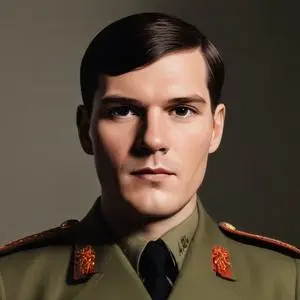
A German colonel who led the failed assassination attempt against Adolf Hitler in 1944, known as Operation Valkyrie, and is celebrated as a hero for his bravery in resisting the Nazi regime.
Claus von Stauffenberg, a German army officer, is best known for his daring attempt to assassinate Adolf Hitler on July 20, 1944, at the Wolfs Lair, a feat that would go down in history as one of the most courageous acts of defiance against the Nazi regime.
As a central figure in the conspiracy against Hitler within the Wehrmacht, Stauffenberg, alongside Major Generals Henning von Tresckow and Hans Oster, risked everything to bring down the tyrannical leader and end the bloody war that had ravaged Europe.
Born on November 15, 1907, in Jettingen, Stauffenberg was the third of four sons of Count Alfred Schenk von Stauffenberg, the last Oberhofmarschall of the Kingdom of Wrttemberg, and Countess Caroline von Üxküll-Gyllenband. From a young age, Stauffenberg was instilled with a strong sense of duty and responsibility, which would serve him well in his later years as a military officer.
Stauffenberg's family was steeped in tradition and military service. His maternal ancestors included Field Marshal August von Gneisenau, a renowned Prussian military leader. Growing up, Stauffenberg and his brothers were members of the Neupfadfinder, a German Scout association, which taught them valuable skills and discipline that would later serve them in their military careers.
In 1926, Stauffenberg joined his family's traditional regiment, the Reiterregiment 17 (17th Cavalry Regiment) in Bamberg, where he began his military training. He was inclined towards literature, but his sense of duty and family expectations led him to pursue a military career.
Stauffenberg took part in several key military campaigns during World War II, including the Invasion of Poland, the 1941-1942 invasion of the Soviet Union in Operation Barbarossa, and the Tunisian campaign.
As the war dragged on, Stauffenberg's disillusionment with the Nazi regime and its brutal policies grew. He became increasingly opposed to Hitler's leadership and the atrocities committed by the regime. This eventually led him to join the conspiracy to overthrow Hitler and bring an end to the war.
On July 20, 1944, Stauffenberg, dressed in full uniform, attended a meeting at the Wolfs Lair, Hitler's Eastern Front headquarters in Rastenburg, Poland. With a briefcase containing a bomb, Stauffenberg made his way to the meeting room, where he placed the briefcase under the table, just a few feet away from Hitler.
The bomb exploded, killing four people and injuring several others, including Hitler, who miraculously survived the blast. Stauffenberg, believing the operation had succeeded, flew back to Berlin, where he and his fellow conspirators waited anxiously for news of Hitler's demise.
Tragically, Hitler survived the assassination attempt, and the conspiracy was quickly uncovered. Stauffenberg and his fellow conspirators were arrested, and after a hasty trial, they were executed by firing squad on July 21, 1944.
Stauffenberg's bravery and selflessness in the face of overwhelming danger have made him a hero in the truest sense. His sacrifice serves as a beacon of hope and inspiration to those who fight against tyranny and oppression.
Stauffenberg's failed assassination attempt may not have succeeded in killing Hitler, but it did galvanize the German resistance movement and inspired others to take a stand against the Nazi regime. His actions also served as a powerful symbol of resistance against oppressive regimes worldwide.
In the decades following World War II, Stauffenberg's story has inspired numerous books, films, and plays, cementing his place in history as a hero of the German resistance. His bravery and sacrifice continue to inspire people around the world to stand up against tyranny and fight for freedom and democracy.
“It is time that our honorable President [Paul von Hindenburg] took a decision, and that the people, who have lived through such a difficult time, should be given a sign that we are not going to let ourselves be driven further, but are ready to take our fate into our own hands.” - Claus von Stauffenberg
Born in 1889
The dictator of Nazi Germany, responsible for the genocide of six million Jews and millions of other people during World War II, and infamous for his extreme nationalist and anti-Semitic ideology.
Born in 1891
A renowned World War II military strategist, known for leading the Afrika Korps and earning the respect of both allies and enemies with his tactical genius.
Born in 1900
Leading the SS and Gestapo, he oversaw the Nazi regime's brutal security apparatus and implemented the "Final Solution," orchestrating the genocide of six million Jews during World War II.
Born in 1893
A high-ranking Nazi official, he was a decorated World War I fighter pilot and later became a prominent politician, serving as Minister President of Prussia. He's infamous for his role in the Nazi regime and war crimes trials.
Born in 1897
A mastermind of Nazi propaganda, he crafted a persuasive narrative that fueled the Third Reich's rise to power, leaving a lasting impact on the world.
Born in 1876
A German naval leader who played a key role in the Kriegsmarine during World War II, overseeing the German U-boat fleet and naval operations. He was a close advisor to Adolf Hitler and implemented the German naval strategy during the war.
Born in 1891
A German naval commander who led the U-boat fleet during World War II and briefly served as President of Germany after Hitler's death, known for his role in the war and its aftermath.
Born in 1890
Chief of the German High Command during World War II, responsible for planning and executing military operations, and signing the unconditional surrender of Germany.
