


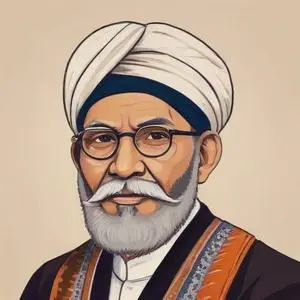
A key figure in India's struggle for independence, he was a pioneering politician and educator who served as the first Asian member of the UK Parliament, advocating for Indian rights and self-rule.
Dadabhai Naoroji, a pioneering Indian Independence activist, political leader, and scholar, is renowned for being the first Asian to become a Member of Parliament in the British House of Commons. His tireless efforts to expose the exploitation of India by the British and his fight for Indian Independence earned him the titles "Grand Old Man of India" and "Unofficial Ambassador of India."
Born on September 4, 1825, in Navsari, Gujarat, India, Naoroji came from a Gujarati-speaking Parsi Zoroastrian family. He attended the Elphinstone Institute School and later became a professor of Mathematics and Natural Philosophy in Elphinstone College, Bombay.
Naoroji's passion for Indian Independence led him to become a prominent leader in the Indian National Congress. He served as its President thrice (1886-1887, 1893-1894, and 1906-1907) and was instrumental in strengthening the organization. His book, "Poverty and Un-British Rule in India," published in 1876, brought attention to the British exploitation of India's resources, highlighting the concept of the "Drain Theory."
In 1892, Naoroji became the second person of Asian descent to be elected to the British House of Commons, representing Finsbury Central for the Liberal Party. This milestone marked a significant step towards greater representation for Indians in British politics. He was also an active member of the Second International, alongside prominent figures like Kautsky and Plekhanov.
In recognition of Naoroji's contributions, India Post has issued stamps in his honor three times (1963, 1997, and 2017). In 2014, the Dadabhai Naoroji Awards were established by Deputy Prime Minister Nick Clegg to acknowledge outstanding services to UK-India relations.
Naoroji was a devout Zoroastrian and founded the Rahnumai Mazdayasan Sabha Guides on the Mazdayasne Path in 1851 to promote the purity and simplicity of his religion. He also established a Gujarati fortnightly publication, Rast Goftar (The Truth Teller), to clarify Zoroastrian concepts and advocate for Parsi social reforms.
Dadabhai Naoroji's unwavering dedication to Indian Independence, social reform, and education has inspired generations. His remarkable achievements and contributions continue to shape India's history and identity.
Born in 1869
Indian freedom fighter, activist, and philosopher who led India to independence from British rule through non-violent civil disobedience, inspiring civil rights movements worldwide.
Born in 1889
India's first Prime Minister, a key figure in the country's struggle for independence from British rule, and a champion of democracy and secularism. He played a crucial role in shaping modern India's government and economy.
Born in 1897
Indian freedom fighter and politician who led the Indian National Army against British rule and was a key figure in the country's struggle for independence. He is also known for his mysterious disappearance in 1945.
Born in 1884
India's first president, a key figure in the country's struggle for independence, who played a crucial role in shaping the nation's early years. He's revered for his leadership and commitment to democracy.
Born in 1875
Indian lawyer and politician who played a key role in India's struggle for independence and later became the country's first Deputy Prime Minister, known for his strong leadership and unification of the country.
Born in 1847
A pioneering figure in women's rights and Indian independence, known for her tireless advocacy and influential writings that inspired generations of activists and thinkers.
Born in 1866
Indian economist and politician who played a key role in India's struggle for independence from British rule, advocating for social and economic reforms. He was a mentor to Mahatma Gandhi and influenced India's early 20th-century politics.
Born in 1865
A leading figure in India's struggle for independence from British rule, known for his role in the Indian independence movement and his advocacy for Hindu-Muslim unity.
