


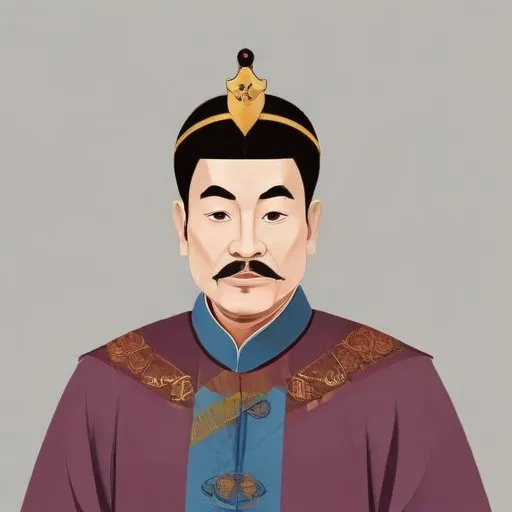
A 19th-century Qing dynasty prince and statesman who played a crucial role in China's foreign policy and modernization efforts, particularly in the Self-Strengthening Movement. He's also known for his diplomatic missions to Europe and the United States.
Daian, a prominent figure in Chinese history, is renowned for his role as a Manchu prince and statesman of the Qing dynasty. He is recognized for his military prowess, administrative skills, and significant contributions to the dynasty's early development.
Born on August 19, 1583, Daian was the second son of Nurhaci, the founder of the Qing dynasty. His mother, Lady Tunggiya, was Nurhaci's first consort. Daian's family background played a significant role in shaping his future, as he was an older half-brother of Nurhaci's successor, Hong Taiji.
Daian's military career began in 1607, when he assisted his father, Nurhaci, in the campaign against the Ula clan and its beile Bujantai. His bravery and tactical skills earned him the title of Guyen Baturu, or "exploring hero." He continued to distinguish himself on the battlefield, playing a crucial role in the capture of Fushun in 1618, the victory at the Battle of Sarh in 1619, and the occupation of Shenyang in 1621.
In 1616, Daian was appointed as one of the Four Senior Beiles, a special rank created by Nurhaci to assist in administration. He, along with Amin, Manggltai, and Hong Taiji, played a vital role in directing state affairs of the Later Jin dynasty. After Nurhaci's death in 1626, Daian used his influence to ensure a smooth transition of power to Hong Taiji.
Daian's contributions to the Qing dynasty were multifaceted. He was a skilled military leader, an effective administrator, and a shrewd diplomat. His role in the early development of the dynasty was instrumental in establishing the foundations for the Qing's subsequent growth and prosperity. Despite his significant achievements, Daian's legacy has often been overshadowed by that of his half-brother, Hong Taiji, who went on to become a prominent emperor of the Qing dynasty.
Daian's life and achievements serve as a testament to his dedication to the Qing dynasty and his commitment to its growth and development. As a prince, statesman, and military leader, Daian played a pivotal role in shaping the course of Chinese history.
Born in 1711
Ruling China from 1735 to 1796, this emperor oversaw a golden age of prosperity, territorial expansion, and cultural achievements, leaving a lasting legacy in Chinese history.
Born in 1678
The fourth emperor of the Qing dynasty, who ruled China from 1722 to 1735, is known for his efficient administration, economic reforms, and military campaigns that expanded the empire's borders. He's also famous for his mysterious death, with rumors of assassination or poisoning.
Born in 1320
The last emperor of the Yuan dynasty in China, he's known for his attempts to restore the Mongol Empire to its former glory, but ultimately failed to prevent its decline.
Born in 1328
Founded the Ming dynasty, reunifying China after a century of fragmentation, and established a strong, centralized government. He's also known for his brutal suppression of opposition and his autocratic rule.
Born in 1507
Ruling China from 1521 to 1566, this emperor oversaw a period of cultural and economic growth, while also being known for his tyrannical behavior and persecution of officials.
