


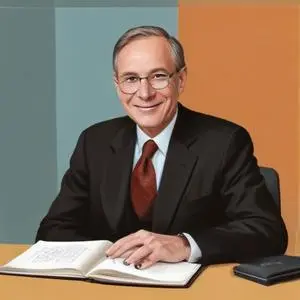
Developed models to analyze labor markets and the job search process, earning the Nobel Prize in Economics in 2010 for his work on frictional unemployment.
Dale T. Mortensen is renowned for his groundbreaking work on the search and matching theory of frictional unemployment, a concept that revolutionized the field of labor economics. Alongside Christopher A. Pissarides and Peter A. Diamond, Mortensen was awarded the Nobel Memorial Prize in Economic Sciences in 2010, cementing his legacy as a trailblazer in modern economics.
Born on February 2, 1939, in Enterprise, Oregon, Mortensen's academic pursuits took him to Willamette University, where he earned his BA in economics in 1961. He then went on to secure his PhD in Economics from Carnegie Mellon University in 1967.
Mortensen's academic career spanned multiple institutions, including Northwestern University, where he served as a professor of Managerial Economics and Decision Sciences at the Kellogg School of Management from 1980 onwards. He also held the position of Niels Bohr Visiting Professor at the School of Economics and Management, Aarhus University, from 2006 to 2010.
Mortensen's research focused on labor economics, macroeconomics, and economic theory, with a particular emphasis on search and matching theory. His work extended to explore labor turnover and reallocation, research and development, and personal relationships, significantly expanding our understanding of the labor market.
Mortensen was married to Beverly Mortensen, a professor at Northwestern University. He passed away on January 9, 2014, at the age of 74, leaving behind a legacy of pioneering work that continues to shape the field of economics.
Mortensen's work has had a profound influence on modern economics, informing policy decisions and shaping our understanding of labor markets. His contributions have been recognized through various honors and awards, solidifying his position as a leading figure in the field.
73 Years Old
A Nobel Prize-winning economist and academic who has made significant contributions to the field of international trade and economic geography, and is also a prominent columnist and author.
83 Years Old
A Nobel Prize-winning economist and academic who has made significant contributions to the field of economics, particularly in the areas of information economics and globalization.
92 Years Old
A renowned economist and philosopher who has made significant contributions to welfare economics, social choice theory, and development economics, and is known for his work on poverty, famine, and human development.
Born in 1912
A Nobel Prize-winning economist who championed free market capitalism and limited government intervention, known for his advocacy of laissez-faire economics and influential writings on monetary policy.
95 Years Old
A pioneer in applying economic theory to social issues, he's most known for his work on human capital, crime and punishment, and the economics of the family.
Born in 1924
A Nobel Prize-winning economist who developed a growth model that showed technological progress is the primary driver of economic growth, and is known for his work on the theory of economic growth.
Born in 1920
Developed econometric models that accurately predicted economic trends and fluctuations, earning him the Nobel Prize in Economics in 1980.
Born in 1918
A Nobel laureate who developed the Tobin tax, a levy on international currency transactions to reduce speculation and stabilize economies. His work has shaped modern economic policy and global finance.
