


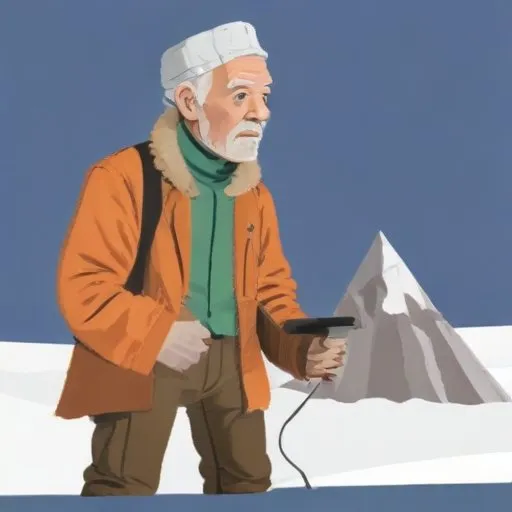
A renowned expert in Antarctic glaciology, he led numerous expeditions and pioneered the use of satellite imagery to study ice sheets. His work significantly advanced our understanding of climate change and its impact on polar regions.
Renowned for his groundbreaking contributions to the fields of glaciology and geophysics, David Drewry is an esteemed scientist of international repute. His remarkable career has been marked by a plethora of achievements, including the conferring of several prestigious awards and honours, solidifying his position as a leading figure in his discipline.
Born on 22 September 1947, in Grimsby, England, David Drewry's early life was marked by a strong academic foundation. He attended Havelock Grammar School (now the Havelock Academy) in Grimsby, before pursuing his higher education at Queen Mary College in east London. It was during this period that he developed a profound interest in geography, graduating with a BSc in the subject in 1969.
Furthering his academic pursuits, Drewry enrolled at Emmanuel College, Cambridge, where he earned his PhD in Glaciology and Geophysics in 1974. His thesis, titled "Subice relief and geology of East Antarctica," laid the foundation for his future research endeavors.
Drewry's illustrious career has been marked by various milestones, including his tenure as a senior research assistant at the Scott Polar Research Institute from 1978 to 1983. He later assumed the role of assistant director of research in 1983, before becoming the director of the Scott Polar Research Institute from 1984 to 1987.
Subsequently, he served as the director of the British Antarctic Survey from 1987 to 1994, a position that underscored his expertise in glaciology and geophysics. His leadership and vision during this period played a pivotal role in shaping the institution's research trajectory.
Drewry's contributions to the scientific community have been recognized through the conferment of several prestigious awards and honours. Some of his notable accolades include:
In addition, the Drewry Ice Stream in Ellsworth Land and Mount Drewry in the Queen Alexandra Range have been named in his honour, a testament to his enduring legacy in the scientific community.
David Drewry is married to Gillian Elizabeth and resides in East Yorkshire and London. His personal life is marked by a sense of quiet humility, which belies his immense contributions to the world of science.
Throughout his illustrious career, David Drewry has left an indelible mark on the fields of glaciology and geophysics. His pioneering research has not only advanced our understanding of the Earth's cryosphere but has also inspired a new generation of scientists to pursue careers in these disciplines.
As the vice-president of the European University Association, Drewry continues to advocate for the advancement of scientific knowledge and its application to real-world problems. His legacy serves as a beacon of inspiration, reminding us of the power of human curiosity and the importance of scientific inquiry.
Born in 1919
A pioneer in environmental science, he proposed the Gaia hypothesis, suggesting the Earth's physical and biological systems are interconnected and behave like a single living organism.
Born in 1681
Led a series of expeditions that mapped much of the Arctic coast of Siberia and discovered several islands, including the Bering Islands. He also led the first European expedition to sight mainland Alaska.
Born in 1868
Led a British expedition to the South Pole, racing against a Norwegian team, and tragically perished on the return journey. He is remembered for his bravery and sacrifice in the pursuit of scientific discovery.
Born in 1874
Led expeditions to the Antarctic, famously surviving a disastrous shipwreck and trekking to safety, earning a legendary reputation for bravery and leadership.
Born in 1872
First person to reach the South Pole, leading a Norwegian expedition in 1911, and a pioneer in Arctic and Antarctic exploration.
Born in 1888
Led the first flights over the North and South Poles, and explored Antarctica, expanding our knowledge of the world's most remote regions.
Born in 1861
A Norwegian pioneer who explored the Arctic, made groundbreaking scientific discoveries, and championed humanitarian causes, earning a Nobel Prize for his efforts. He's most famous for being the first to cross Greenland and his innovative sled designs.
70 Years Old
First person to walk solo to both the North and South Poles, raising awareness about environmental protection and inspiring others to take action.
