


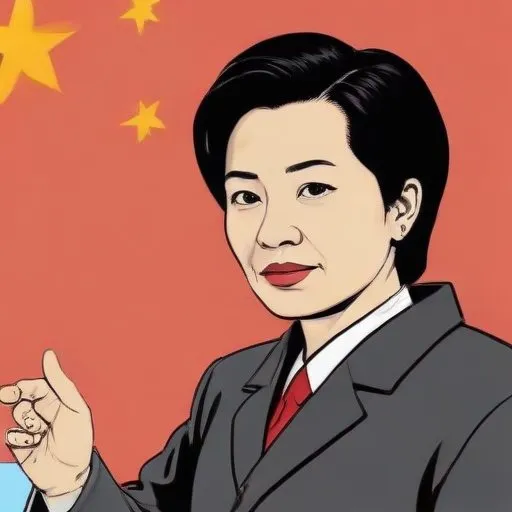
A pioneering female politician who played a crucial role in shaping modern China's politics and social reforms, particularly in women's rights and education.
Deng Yingchao, a name synonymous with courage, resilience, and determination, is renowned for her pivotal role in shaping China's political landscape as the Chairwoman of the Chinese People's Political Consultative Conference from 1983 to 1988. As the wife of the first Chinese Premier, Zhou Enlai, she carved out her own niche as a champion of women's rights, breaking barriers and defying conventions in a male-dominated society.
Born on February 4, 1904, in Nanning, Guangxi, Deng Yingchao grew up in a poverty-stricken family, where her father's untimely demise forced her single mother to teach and practice medicine to make ends meet. Despite the odds, Deng's mother instilled in her the value of education, which would later become the cornerstone of her remarkable journey.
Deng's involvement in the May Fourth Movement as a team leader in 1919 marked the beginning of her political awakening. It was during this tumultuous period that she met her future husband, Zhou Enlai, with whom she would share a lifelong commitment to the Chinese Communist Party. In 1924, Deng joined the Communist Youth League of China, and a year later, she became a member of the Chinese Communist Party, solidifying her position as a dedicated activist.
In 1934, Deng embarked on the treacherous Long March, a 6,000-mile journey that tested the resolve of even the most hardened revolutionaries. She was one of the few women to survive this grueling ordeal, which would later become a defining moment in her life. However, the journey took a toll on her health, as she developed pulmonary tuberculosis, a condition that would plague her for years to come.
After the victory of the Anti-Japanese War, Deng Yingchao attended the first Political Consultative Conference in Chongqing as the only female representative of the Chinese Communist Party. Her unwavering commitment to the party earned her a spot on the Executive Council of the Women's International Democratic Federation in 1948 and 1953. In 1949, she was elected to the Preparatory Committee of the National Committee of the Chinese People's Political Consultative Conference, cementing her status as a prominent figure in Chinese politics.
Deng Yingchao's later years were marked by her tireless efforts to promote women's rights and social welfare. She served as the Chairwoman of the Chinese People's Political Consultative Conference from 1983 to 1988, using her platform to advocate for education, healthcare, and economic empowerment for women. Her lifelong dedication to the cause earned her numerous accolades, including the title of "Mother of Chinese Women."
Deng Yingchao's remarkable life serves as a testament to the power of human resilience and determination. Her unwavering commitment to the Chinese Communist Party and her unrelenting advocacy for women's rights have inspired generations of Chinese women to pursue careers in politics and beyond. As a champion of social justice, Deng Yingchao's legacy continues to inspire and empower individuals around the world.
Born in 1893
Leader of the Chinese Communist Party who implemented radical social and economic reforms, including the Great Leap Forward and the Cultural Revolution, shaping modern China's politics and economy.
Born in 1898
The first Premier of the People's Republic of China, serving from 1949 until his death in 1976, is most known for his key role in the Chinese Communist Party and his diplomatic efforts to improve relations with the West. He played a crucial part in shaping China's foreign policy and economy during a pivotal period in the country's history.
73 Years Old
A renowned Chinese violinist and composer, blending Eastern and Western musical styles, creating a unique sound that showcases cultural fusion.
Born in 1898
A prominent military leader who played a crucial role in the Chinese Civil War and later became a key figure in the Communist Party, known for his criticisms of Mao's policies. He was eventually purged and persecuted during the Cultural Revolution.
Born in 1896
A prominent Chinese military leader and politician who played a key role in the Chinese Civil War and later served as the 1st Vice Premier of the People's Republic of China, known for his efforts in modernizing the Chinese military. He was a close ally of Mao Zedong and helped establish the People's Liberation Army.
Born in 1897
A Chinese military leader and politician who served as the Head of State of the People's Republic of China, playing a crucial role in the country's modernization and reform. He's most known for his efforts in stabilizing the country after Mao's death and introducing economic reforms.
