


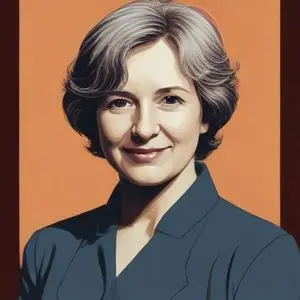
A pioneering scholar who has written extensively on the intersection of technology, gender, and species, challenging traditional notions of humanity and its relationship with machines and nature.
Donna Haraway is a renowned American professor emerita, celebrated for her groundbreaking contributions to the fields of science and technology studies, feminist theory, and contemporary ecofeminism. She is particularly known for her critiques of anthropocentrism, emphasizing the self-organizing powers of nonhuman processes and exploring dissonant relations between those processes and cultural practices.
Donna Jeanne Haraway was born on September 6, 1944, in Denver, Colorado. She grew up in a family of modest means, with her father, Frank O. Haraway, working as a sportswriter for The Denver Post. This humble beginning instilled in her a strong work ethic and passion for learning.
Haraway's academic journey began at the University of Colorado, where she earned her Bachelor's degree in zoology and philosophy (1966). She later pursued her Ph.D. in biology at Yale University (1972). Her academic career spanned over four decades, with teaching stints at the University of Hawaii, Johns Hopkins University, and the University of California, Santa Cruz, where she became the first tenured professor in feminist theory in the United States (1980).
Haraway's work has sparked debate and inspired new perspectives in primatology, philosophy, and developmental biology. Her critiques of anthropocentrism and emphasis on nonhuman processes have influenced contemporary ecofeminism, challenging traditional notions of ethics and humanity's relationship with the environment.
Her philosophical contributions include the concept of "cyborgs" and "companion species," which highlight the interconnectedness of humans, animals, and machines. These ideas have far-reaching implications for fields like environmentalism, animal studies, and science policy.
Donna Haraway's work has left an indelible mark on the fields of science and technology studies, feminist theory, and contemporary ecofeminism. Her contributions have inspired a new generation of scholars, activists, and thinkers, ensuring her legacy as a pioneer in these fields.
As her work continues to inspire and challenge, Haraway's impact will be felt for years to come, shaping our understanding of the complex relationships between humans, animals, and technology.
70 Years Old
A renowned philosopher and gender theorist who challenged traditional notions of identity, gender, and sexuality through influential works like "Gender Trouble," shaping modern feminist and queer thought.
84 Years Old
A pioneering postcolonial theorist and feminist scholar, known for challenging dominant Western discourses and advocating for the voices of marginalized communities. Her work has reshaped literary theory, cultural studies, and globalization debates.
74 Years Old
A prominent writer and social activist, known for her groundbreaking work on race, gender, and class, and her influential books on feminism and social justice.
Born in 1926
A French historian and philosopher who critiqued power structures and social norms, arguing that knowledge and truth are shaped by those in power. He's known for his concepts of power, discipline, and surveillance.
97 Years Old
A French sociologist and philosopher who developed theories on consumerism, hyperreality, and the simulation of reality, arguing that our postmodern world is more concerned with images and appearances than reality itself.
Born in 1908
A pioneering feminist philosopher who wrote extensively on ethics, politics, and gender, famously arguing that "one is not born, but rather becomes, a woman."
Born in 1889
A German philosopher and academic who explored the meaning of existence, time, and human existence, influencing 20th-century philosophy with his concept of "Being-in-the-world".
