


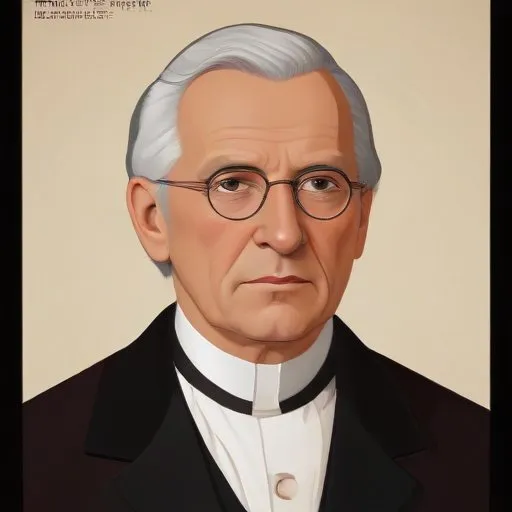
A 17th-century polymath who made significant contributions to mathematics, physics, and medicine, and is credited with being the first to discover the secret of porcelain production in Europe.
Ehrenfried Walther von Tschirnhaus, a German polymath, left an indelible mark on mathematics, physics, medicine, and philosophy. He is renowned for introducing the Tschirnhaus transformation, a groundbreaking algebraic equation solution method, and is often credited with inventing European porcelain, a feat long attributed to Johann Friedrich Böttger.
Von Tschirnhaus was born on April 10, 1651, in Kieslingswalde, Western Poland (now Świątnikowice). His birthplace, nestled in the heart of Europe, would later influence his curiosity and passion for exploration.
Von Tschirnhaus attended the Gymnasium at Grlitz, laying the foundation for his future academic pursuits. He then studied mathematics, philosophy, and medicine at the prestigious University of Leiden. During his time in Leiden, he developed a thirst for knowledge, which led him to travel extensively throughout France, Italy, and Switzerland. In 1672-1673, he served in the army of Holland, further broadening his horizons.
Von Tschirnhaus's journeys allowed him to rub shoulders with some of the most brilliant minds of his era. He met Baruch de Spinoza and Christiaan Huygens in the Netherlands, Isaac Newton in England, and Gottfried Wilhelm Leibniz in Paris. His interactions with Leibniz blossomed into a lifelong correspondence, fostering a rich exchange of ideas.
Von Tschirnhaus's most notable mathematical achievement is the Tschirnhaus transformation, published in the scientific journal Acta Eruditorum in 1683. This innovation enabled the removal of intermediate terms from algebraic equations, simplifying complex calculations.
Von Tschirnhaus is often credited with inventing European porcelain, although this claim is disputed by some historians. Despite the controversy, his work in this field remains significant, as he experimented with various materials and techniques to create high-quality porcelain.
Von Tschirnhaus's multifaceted contributions have had a lasting impact on mathematics, physics, and art. His work has inspired generations of scholars, and his legacy continues to inspire innovation and discovery.
Von Tschirnhaus passed away on October 11, 1708, in Dresden, Saxony, leaving behind a rich tapestry of achievements that continue to fascinate and educate us today.
Born in 1646
Developed calculus independently of Isaac Newton, and made major contributions to the fields of philosophy, politics, and history.
Born in 1629
A 17th-century polymath who made groundbreaking contributions to optics, probability theory, and astronomy, including the discovery of Saturn's rings and the largest moon, Titan.
Born in 1623
A 17th-century genius who made major contributions to mathematics, physics, and philosophy, inventing the mechanical calculator and developing the theory of probability. His writings also explored the human condition and faith.
Born in 1588
A 17th-century polymath who made significant contributions to mathematics, particularly in the discovery of prime numbers, and wrote extensively on philosophy and theology.
Born in 1608
Developed the mercury barometer, a device that measures atmospheric pressure, and made significant contributions to the study of vacuums and fluids.
Born in 1601
A 17th-century polymath who deciphered ancient texts, developed musical theories, and wrote extensively on geology, medicine, and astronomy, making him a Renaissance man of sorts.
