


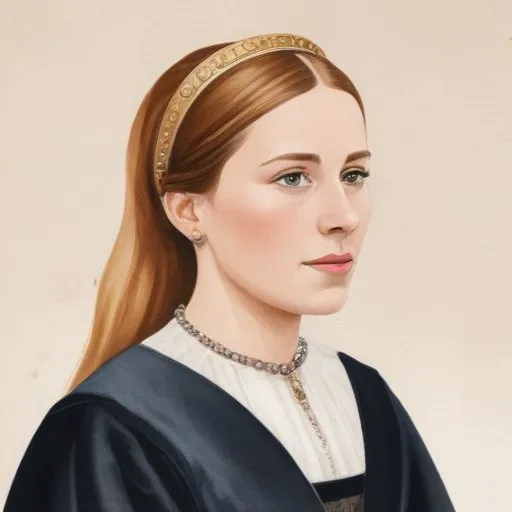
A 17th-century German princess who defied convention by pursuing philosophy and corresponding with famous thinkers like Descartes, making significant contributions to the development of modern philosophy. She's also known for her strong Calvinist faith and its influence on her writings.
Known for her groundbreaking correspondence with the renowned philosopher René Descartes, Elisabeth of the Palatinate was a 17th-century German philosopher who made significant contributions to the field of metaphysics. Her incisive critiques of Descartes' dualistic metaphysics anticipated the concerns of later philosophers, cementing her position as a trailblazer in the world of philosophy.
Born on December 26, 1618, in Heidelberg, Germany, Elisabeth was the eldest daughter of Frederick V, Elector Palatine, and Elizabeth Stuart. She was the third of thirteen children, and her family's tumultuous history led to her parents being forced into exile in the Netherlands in 1620. Elisabeth spent her early years with her grandmother, Louise Juliana of Nassau, in Heidelberg before joining her family in the Netherlands at the age of nine.
Elisabeth received a comprehensive education, studying a wide range of subjects including philosophy, astronomy, mathematics, jurisprudence, history, and modern and classical languages. Her siblings affectionately nicknamed her "La Grecque" (The Greek) due to her exceptional proficiency in ancient Greek. Additionally, she pursued the fine arts, including painting, music, and dancing, and may have been tutored by the celebrated poet and musician Constantijn Huygens.
In 1643, Elisabeth initiated a correspondence with René Descartes, which lasted for several years. Her letters showcased her exceptional philosophical acumen, as she probed the implications of Descartes' metaphysical ideas. Elisabeth's critiques of Descartes' work were characterized by their precision and insight, and she famously challenged his mind-body dualism. Her philosophical queries compelled Descartes to reevaluate his own ideas, leading to significant revisions in his subsequent writings.
Elisabeth's philosophical contributions extended beyond her correspondence with Descartes. Her work prefigured the metaphysical concerns of later philosophers, including the German philosopher Gottfried Wilhelm Leibniz. Her unique blend of philosophical rigor and intellectual curiosity earned her recognition as a pioneering figure in the history of philosophy.
Elisabeth of the Palatinate's remarkable philosophical contributions and correspondence with Descartes have left an indelible mark on the history of philosophy. Her work continues to inspire scholars and philosophers, ensuring her legacy as a trailblazing figure in the development of modern philosophy.
Moreover, Elisabeth's life and achievements serve as a testament to the power of women's intellectual agency and the importance of promoting philosophical inquiry and dialogue across cultural and social boundaries.
Born in 1596
Developed influential philosophical and mathematical concepts, including the famous phrase "I think, therefore I am," and laid the foundation for modern Western philosophy.
Born in 1632
A 17th-century thinker who laid the groundwork for modern democracy, arguing that governments derive their power from the people and that individuals have inherent rights to life, liberty, and property.
Born in 1646
Developed calculus independently of Isaac Newton, and made major contributions to the fields of philosophy, politics, and history.
Born in 1632
A 17th-century philosopher and scholar who developed a comprehensive philosophical system that emphasizes God, nature, and human freedom, influencing modern thought on ethics, politics, and religion.
Born in 1724
Developed influential philosophical frameworks, such as the Critique of Pure Reason, that shaped modern Western thought on ethics, morality, and human understanding.
Born in 1712
A pioneering thinker who shaped modern democracy and education with his ideas on social contracts, general will, and the importance of early childhood education. His writings influenced the French Revolution and modern political thought.
Born in 1694
A witty and insightful 18th-century writer and philosopher who used satire to critique societal norms and advocate for reason, tolerance, and human rights.
Born in 1607
A 17th-century Dutch painter and engraver, known for being one of the first female artists to achieve international recognition and for her detailed and intricate works of art.
