


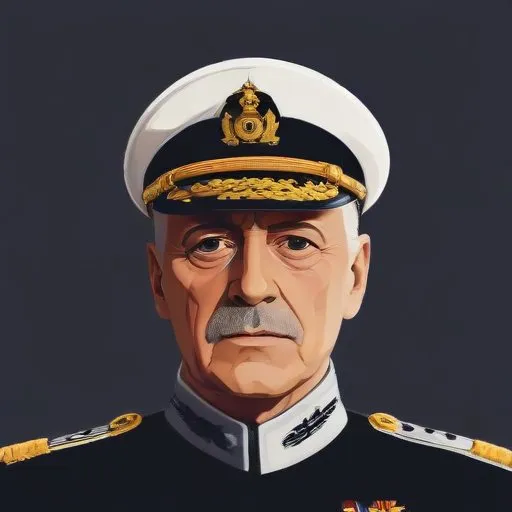
A decorated U-boat commander in World War II, credited with sinking numerous Allied ships, earning him the Knight's Cross of the Iron Cross with Oak Leaves and Swords.
Erich Topp was a renowned German U-boat commander during World War II, distinguished for his exceptional naval leadership and remarkable combat achievements. With a storied career that spanned multiple decades, Topp earned the esteemed Knight's Cross of the Iron Cross with Oak Leaves and Swords, one of Nazi Germany's highest military honors.
Born on July 2, 1914, in Hannover, Germany, Erich Topp embarked on his naval journey in 1934, joining the Reichsmarine as a cadet. Following his basic training, he served on the school ship Gorch Fock and later on the light cruiser Karlsruhe, participating in its fourth training cruise.
Topp's outstanding performance and dedication led to his rapid advancement through the ranks. He attended the main cadet course at the Naval Academy Mürwik, completing it in 1936. Subsequently, he was promoted to Fähnrich zur See (officer cadet) and later to Leutnant zur See (second lieutenant) in 1937.
In 1939, Topp began his U-boat training, eventually becoming the commander of U-552. Under his leadership, the U-552 achieved remarkable success, sinking 35 ships with a total tonnage of 197,460 gross register tons (GRT). This exceptional combat record earned Topp the Knight's Cross of the Iron Cross with Oak Leaves and Swords in 1942.
After the war, Topp continued to serve in the Federal German Navy, rising to the rank of Konteradmiral (rear admiral). He played a significant role in NATO, contributing to the organization's naval strategies and operations.
Erich Topp passed away on December 26, 2005, leaving behind a legacy as one of the most accomplished U-boat commanders in history. His remarkable career, marked by bravery, skill, and dedication, continues to inspire and fascinate historians and naval enthusiasts alike.
Topp's military achievements and leadership have had a lasting impact on the field of naval warfare. His experiences and insights have contributed to the development of modern naval strategies and tactics, shaping the course of naval history.
Erich Topp's remarkable life and career serve as a testament to his unwavering commitment to his country and his profession. His legacy continues to captivate and inspire, offering valuable insights into the complex and often tumultuous world of naval warfare.
Born in 1891
A German naval commander who led the U-boat fleet during World War II and briefly served as President of Germany after Hitler's death, known for his role in the war and its aftermath.
Born in 1896
A renowned fighter pilot and aerobatic champion, known for his exceptional flying skills and charismatic personality, which made him a celebrated figure in Nazi Germany.
Born in 1893
A high-ranking Nazi official, he was a decorated World War I fighter pilot and later became a prominent politician, serving as Minister President of Prussia. He's infamous for his role in the Nazi regime and war crimes trials.
Born in 1888
A pioneering tank commander who revolutionized modern warfare with his innovative blitzkrieg tactics, earning him the nickname "Father of the Panzerwaffe".
Born in 1880
A German field marshal who led the Wehrmacht during World War II, playing a key role in the invasion of Poland and the Battle of Moscow. He was a prominent figure in the German high command during the war.
Born in 1876
A German naval leader who played a key role in the Kriegsmarine during World War II, overseeing the German U-boat fleet and naval operations. He was a close advisor to Adolf Hitler and implemented the German naval strategy during the war.
Born in 1913
A highly decorated U-boat commander in World War II, known for sinking over 200,000 tons of Allied shipping, earning him the Knight's Cross of the Iron Cross with Oak Leaves and Swords.
Born in 1908
A German U-boat captain who sank the British battleship HMS Royal Oak in 1939, earning him the nickname "The Bull of Scapa Flow" and making him a celebrated war hero in Germany.
