


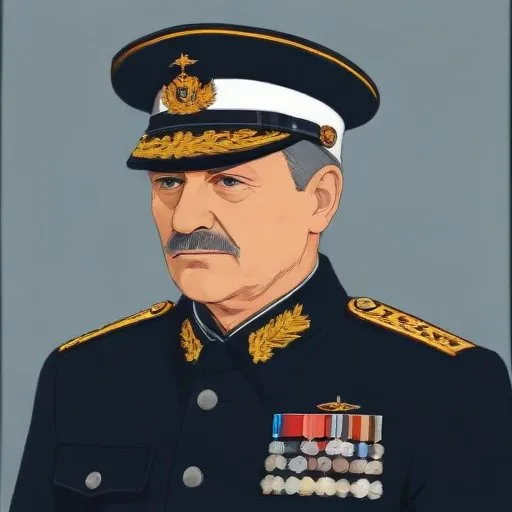
A highly decorated U-boat commander in World War II, known for sinking over 200,000 tons of Allied shipping, earning him the Knight's Cross of the Iron Cross with Oak Leaves and Swords.
Wolfgang Lüth, a German U-boat captain, left an indelible mark on the annals of World War II. Credited with the sinking of 46 merchant ships, including the French submarine Doris, Lüth's impressive tally of 225,204 gross register tons (GRT) earned him the notorious reputation as one of the most successful U-boat commanders of the war.
Born on October 15, 1913, in Riga, then part of the Russian Empire, Lüth was a Baltic German who developed a passion for the sea. After completing his Abitur certificate, he began studying law at the Herder-Institut, but soon abandoned his studies to join the German Reichsmarine (later renamed Kriegsmarine) on April 1, 1933, as an officer candidate.
Following basic military training, Lüth was transferred to the training ship Gorch Fock, where he attained the rank of Seekadett (naval cadet) on September 23, 1933. He served with the surface fleet, embarking on a nine-month training tour around the world in the cruiser Karlsruhe from September 24, 1933, to June 27, 1934. Lüth advanced in rank to Fähnrich zur See (midshipman) on July 1, 1934.
In 1936, Lüth transferred to the U-boat service, an assignment that would catapult him to fame. He began his U-boat career as a watch officer on U-27, before taking command of U-9 in December 1939. Lüth's early successes led to subsequent commands of U-138 and U-43, where he honed his skills and built his reputation as a formidable U-boat captain.
During his 15 war patrols, Lüth sank numerous ships, including the French submarine Doris, earning him the respect and fear of his enemies. His impressive record earned him the Knights Cross of the Iron Cross with Oak Leaves, Swords, and Diamonds, an honor bestowed upon only two U-boat commanders during World War II.
Lüth's final service position was as commander of the Naval Academy Mürwik near Flensburg. Tragically, he was accidentally shot and killed by a German sentry on the night of May 13-14, 1945, just after the war's end. Lüth was given a state funeral by the Flensburg Government on May 16, 1945, a testament to his esteemed position within the Kriegsmarine.
Wolfgang Lüth's remarkable career serves as a testament to his bravery, tactical prowess, and unwavering dedication to his country. Though his actions were shrouded in controversy, Lüth remains an important figure in World War II history, an emblem of the destructive power and strategic importance of the U-boat fleet.
Wolfgang Lüth's remarkable story continues to captivate historians and enthusiasts alike, serving as a poignant reminder of the complexities and tragedies of war.
Born in 1891
A German naval commander who led the U-boat fleet during World War II and briefly served as President of Germany after Hitler's death, known for his role in the war and its aftermath.
Born in 1876
A German naval leader who played a key role in the Kriegsmarine during World War II, overseeing the German U-boat fleet and naval operations. He was a close advisor to Adolf Hitler and implemented the German naval strategy during the war.
Born in 1888
A pioneering tank commander who revolutionized modern warfare with his innovative blitzkrieg tactics, earning him the nickname "Father of the Panzerwaffe".
Born in 1880
A German field marshal who led the Wehrmacht during World War II, playing a key role in the invasion of Poland and the Battle of Moscow. He was a prominent figure in the German high command during the war.
Born in 1882
A high-ranking military officer who played a crucial role in World War II, particularly in the Battle of France and the plot to assassinate Adolf Hitler.
Born in 1882
A high-ranking Nazi officer who served as the Chief of the OKW, the German High Command, during World War II, and was known for his unwavering loyalty to Hitler. He was tried and executed for war crimes after the war.
Born in 1890
Chief of the German High Command during World War II, responsible for planning and executing military operations, and signing the unconditional surrender of Germany.
Born in 1887
A highly decorated military strategist who played a crucial role in several key battles during World War II, including the invasion of France and the Siege of Leningrad.
