


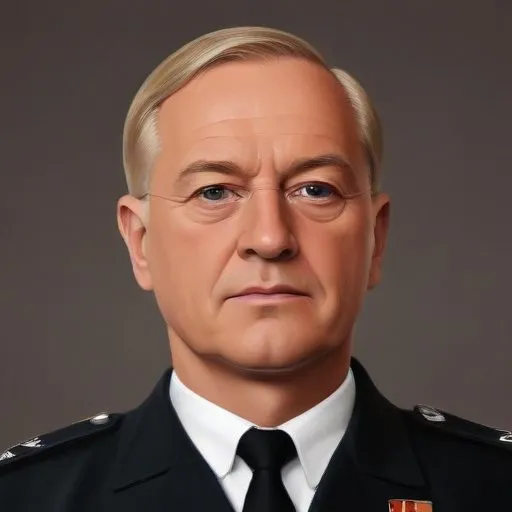
A high-ranking German intelligence officer who played a crucial role in the resistance against the Nazi regime, providing vital information to the Allies and participating in plots to assassinate Hitler.
Erwin von Lahousen, a decorated Austrian officer, was a key figure in the German Resistance, working tirelessly to assassinate Adolf Hitler during World War II. As a member of the Abwehr, Germany's military intelligence agency, Lahousen played a duplicitous role, feeding vital information to the Allies while secretly plotting against the Führer.
Born on October 25, 1897, into an aristocratic family, Lahousen's early life was marked by a strong sense of duty and loyalty. He served in the Austro-Hungarian Army during World War I, later joining Austria's counterintelligence agency after the war.
Following Austria's annexation by Nazi Germany in 1938, Lahousen's intelligence services were absorbed into the Abwehr, headed by Admiral Wilhelm Canaris. The two men developed a close bond, sharing anti-Nazi sentiments and a desire to undermine Hitler's regime. Canaris appointed Lahousen chief of Abwehr Section II, responsible for sabotage and special operations.
Lahousen's sabotage expertise was instrumental in the successful invasion of Poland in 1939. However, his focus on espionage over sabotage led to disastrous results. Trained agents sent to Britain were prioritized for spying, resulting in numerous failures. In 1942, a group of saboteurs sent to the United States as part of Operation Pastorius were betrayed to the FBI, leading to their capture, trial, and execution.
In 1943, Lahousen was reassigned to the Eastern Front, escaping the Abwehr's downfall. He later claimed to have supplied the bomb used in the Smolensk plot, Operation Spark, on March 13, 1943. Although the assassination attempt failed, Lahousen continued to secretly support the German Resistance.
Lahousen's involvement in the 20 July plot, a failed assassination attempt on Hitler, led to the execution of Claus von Stauffenberg and thousands of other accused plotters, including Canaris. Lahousen's actions ultimately contributed to the decline of the Abwehr and the rise of the Gestapo.
Erwin von Lahousen's life was marked by duplicity and courage. He walked a tightrope, balancing his loyalty to Germany with his moral obligation to resist the Nazi regime. His story serves as a testament to the power of human conscience and the bravery of those who dared to challenge the status quo.
Lahousen's actions significantly impacted the course of World War II, contributing to the eventual downfall of the German war machine. His legacy serves as a reminder of the importance of moral courage in the face of overwhelming adversity.
Born in 1889
The dictator of Nazi Germany, responsible for the genocide of six million Jews and millions of other people during World War II, and infamous for his extreme nationalist and anti-Semitic ideology.
Born in 1893
A high-ranking Nazi official, he was a decorated World War I fighter pilot and later became a prominent politician, serving as Minister President of Prussia. He's infamous for his role in the Nazi regime and war crimes trials.
Born in 1897
A mastermind of Nazi propaganda, he crafted a persuasive narrative that fueled the Third Reich's rise to power, leaving a lasting impact on the world.
Born in 1900
Leading the SS and Gestapo, he oversaw the Nazi regime's brutal security apparatus and implemented the "Final Solution," orchestrating the genocide of six million Jews during World War II.
Born in 1893
A German diplomat who served as the Nazi regime's Foreign Minister, orchestrating key alliances and treaties that led to World War II. He was a close associate of Adolf Hitler and played a crucial role in shaping Nazi foreign policy.
Born in 1876
A German naval leader who played a key role in the Kriegsmarine during World War II, overseeing the German U-boat fleet and naval operations. He was a close advisor to Adolf Hitler and implemented the German naval strategy during the war.
Born in 1891
A German naval commander who led the U-boat fleet during World War II and briefly served as President of Germany after Hitler's death, known for his role in the war and its aftermath.
Born in 1882
A high-ranking Nazi officer who served as the Chief of the OKW, the German High Command, during World War II, and was known for his unwavering loyalty to Hitler. He was tried and executed for war crimes after the war.
