


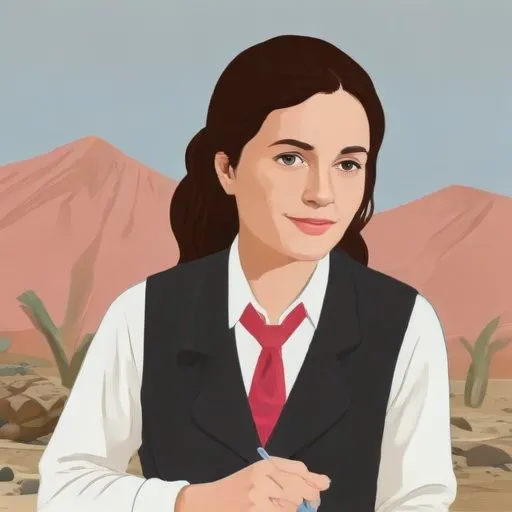
Pioneering female geologist and paleontologist who contributed significantly to the field of micropaleontology, particularly in the study of foraminifera and their role in oil exploration.
Esther Applin, a trailblazing American geologist and paleontologist, is renowned for her groundbreaking contributions to the field of micropaleontology, particularly in the use of microfossils to determine the age of rock formations for oil exploration in the Gulf of Mexico region.
Applin's remarkable career was marked by her innovative approach to geology. She focused on microfossils, particularly foraminifera, to determine the age of rock formations, which was crucial for successful drilling operations in the oil industry. Her work led to significant discoveries, enabling oil companies to identify potential oil-bearing rocks and subsequently extract valuable resources.
Esther Richards, later Applin, was born on November 24, 1895, in Newark, Ohio, to Gary Richards, a civil engineer with the United States Army, and Jennie DeVore. Due to her father's work, she lived in various cities in Ohio, Iowa, and eventually settled in San Francisco at the age of 12. She spent her teenage years on Alcatraz Island, where her father worked on the construction of Alcatraz Prison.
Applin attended the University of California, Berkeley, graduating in 1919 with an honors degree in paleontology, geology, and physiography. Her undergraduate studies focused on larger fossils, but she soon realized that this theoretical education was of limited value for underground drilling. She then shifted her attention to microfossils, which became the cornerstone of her groundbreaking work.
Applin's work embodied a fundamental shift in the geology community's understanding of the importance of microfossils in oil exploration. Her discoveries demonstrated that these tiny organisms held the key to unlocking the secrets of rock formations, enabling the oil industry to tap into previously inaccessible resources.
Her pioneering spirit and innovative approach paved the way for future generations of geologists, particularly women, to earn recognition and respect in the field. Applin's achievements served as a testament to the power of determination and perseverance in the pursuit of scientific knowledge.
Esther Applin's contributions have had a profound impact on the oil industry, enabling the discovery of new oil reserves and shaping the course of energy exploration. Her work has also inspired generations of geologists, paleontologists, and scientists, fostering a deeper understanding of the Earth's geological history and the importance of microfossils in this context.
Today, Applin is remembered as a trailblazer who broke down barriers for women in geology, paving the way for future generations to make their mark in the field. Her remarkable achievements continue to inspire and motivate scientists, researchers, and explorers around the world.
Applin's groundbreaking work earned her numerous accolades, including the prestigious Award of the Gulf Coast Section of the American Association of Petroleum Geologists. Her contributions have been recognized by the geology community, and she remains one of the most celebrated female geologists of the 20th century.
Esther Applin's remarkable story serves as a testament to the power of innovation, perseverance, and determination in the pursuit of scientific knowledge. Her groundbreaking contributions continue to inspire and motivate scientists, researchers, and explorers around the world.
Born in 1834
Led a groundbreaking expedition down the Colorado River, mapping the Grand Canyon and making significant geological discoveries. He's considered one of the most important figures in the exploration of the American West.
Born in 1843
Pioneering geologist who revolutionized the field with groundbreaking research on plate tectonics, earthquakes, and the geological history of the American West.
Born in 1799
A pioneering fossil hunter who uncovered several groundbreaking dinosaur discoveries, including the first complete plesiosaur skeleton, significantly advancing our understanding of prehistoric life.
Born in 1784
A pioneering geologist and paleontologist who discovered dinosaur fossils and coined the term "coprolite" for fossilized dung, making significant contributions to the field of paleontology.
Born in 1769
Founded the field of comparative anatomy, establishing extinction as a fact and creating a framework for understanding the natural world through fossil records.
Born in 1744
A French soldier, biologist, and academic who developed a theory of inheritance of acquired characteristics, proposing that organisms adapt to their environment and pass on those traits to their offspring.
Born in 1797
A Scottish geologist who pioneered the concept of uniformitarianism, which states that the Earth's geological features were shaped by slow, gradual processes over millions of years. His work laid the foundation for modern geology and influenced Charles Darwin's theory of evolution.
Born in 1726
Pioneering geologist and physician who formulated the theory of uniformitarianism, proposing that the Earth's geological features were shaped by slow, gradual processes over millions of years.
