


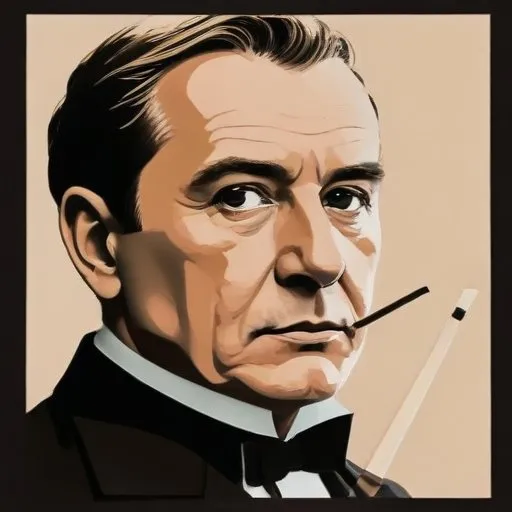
A renowned German conductor, he led prestigious orchestras, including the Berlin Philharmonic, and was particularly acclaimed for his interpretations of Bruckner, Wagner, and Strauss.
Eugen Jochum, a German conductor of unparalleled renown, is best known for his mesmerizing interpretations of the music of Anton Bruckner, Carl Orff, and Johannes Brahms. His profound understanding and mastery of these composers' works earned him a place among the most esteemed conductors of the 20th century.
Born on November 1, 1902, in Babenhausen, near Augsburg, Germany, Jochum came from a musical family. His father, an organist and conductor, instilled in him a deep love for music from a young age. Jochum's early education in music began in Augsburg, where he studied piano and organ at the Academy of Music from 1914 to 1922. He later continued his studies at the Munich Conservatory, where he developed a passion for conducting under the guidance of Siegmund von Hausegger, a prominent conductor and composer.
Jochum's professional journey began as a rehearsal pianist in München-Gladbach and later in Kiel. In 1926, he made his conducting debut with the Munich Philharmonic Orchestra, leading a performance of Bruckner's Seventh Symphony. This marked the beginning of his ascension to prominence in the world of classical music.
In 1926, Jochum was appointed conductor at the Kiel Opera House, where he presented an impressive 17 operas in his first season, including Der fliegende Holländer, Der Rosenkavalier, and Turandot. His success in Kiel led to further appointments in Mannheim, Duisburg, and Berlin, where he became the chief of the Berlin Radio Orchestra and conducted regular concerts with the Berlin Philharmonic.
Jochum's profound understanding of Bruckner's music was unparalleled, and his interpretations of the composer's symphonies remain among the most revered and sought-after. He was also celebrated for his performances of Brahms' works, particularly the German Requiem, which he recorded with the Berlin Philharmonic in 1956.
Jochum's unique approach to conducting was characterized by his emphasis on the spiritual and emotional depth of the music. He was known for his ability to coax rich, sonorous textures from the orchestra, and his performances were often described as transcendent and sublime.
Jochum's impact on the world of classical music extends far beyond his own performances. He was a mentor and inspiration to countless young conductors, and his recordings continue to influence and inspire new generations of musicians.
Throughout his career, Jochum received numerous awards and honors, including the Bundesverdienstkreuz (Federal Cross of Merit) and the title of Professor h.c. from the University of Hamburg. His legacy continues to be celebrated through his extensive discography, which remains a testament to his profound artistry and musical vision.
"Music is the divine language, and the conductor is its interpreter."
"A good conductor is not one who conducts the orchestra, but one who inspires the orchestra to conduct itself."
These quotes offer a glimpse into Jochum's profound philosophy on music and conducting, and continue to inspire and guide musicians to this day.
Born in 1908
A renowned maestro who led the Berlin Philharmonic for over three decades, elevating its reputation through precise and dramatic performances. He's also famous for his numerous recordings and charismatic stage presence.
Born in 1886
A renowned German conductor and composer, he was a dominant figure in the Berlin Philharmonic, known for his intense and expressive performances of Beethoven, Brahms, and Bruckner. He was also a composer of symphonies and other works.
Born in 1888
A renowned German conductor, celebrated for his interpretations of Richard Wagner's operas, particularly his iconic performances of "Der Ring des Nibelungen" at the Bayreuth Festival.
Born in 1894
A renowned opera conductor and director, celebrated for his interpretations of Mozart, Wagner, and Strauss, leading top orchestras and opera houses worldwide.
Born in 1912
A renowned maestro who led the Chicago Symphony Orchestra to international acclaim, known for his intense performances and numerous recordings of operas and symphonies.
Born in 1885
A renowned composer and conductor, known for his interpretations of Beethoven and Bruckner, and his leadership of the Berlin State Opera and Los Angeles Philharmonic.
Born in 1890
A renowned opera conductor and director, known for his innovative productions and interpretations of Mozart and Verdi operas. He was a pioneer in the revival of Mozart's operas in the early 20th century.
Born in 1896
A renowned Greek musician who excelled as a pianist, composer, and conductor, leading major orchestras and premiering numerous works. He's particularly famous for his interpretations of Mahler and his advocacy for modern classical music.
