


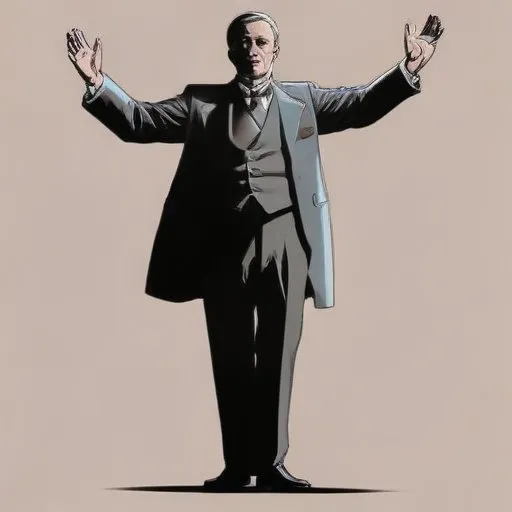
A renowned German conductor, celebrated for his interpretations of Richard Wagner's operas, particularly his iconic performances of "Der Ring des Nibelungen" at the Bayreuth Festival.
Hans Knappertsbusch was a renowned German conductor, celebrated for his riveting performances of the music of Richard Wagner, Anton Bruckner, and Richard Strauss. His profound understanding and interpretation of these iconic composers' works earned him a reputation as one of the most prominent conductors of the 20th century.
Born in Elberfeld (now Wuppertal), Germany on March 12, 1888, Knappertsbusch was the second son of a manufacturer, Gustav Knappertsbusch, and his wife Julie, née Wiegand. He displayed a remarkable aptitude for music from an early age, playing the violin and cornet. By the age of 12, he was conducting his high school orchestra, foreshadowing his future career.
Despite his parents' initial disapproval, Knappertsbusch pursued his passion for music, studying philosophy at Bonn University and later attending the Cologne Conservatory. Under the guidance of principal Fritz Steinbach, he honed his conducting skills. His summers as an assistant to Siegfried Wagner and Hans Richter at the Bayreuth Festival were instrumental in shaping his artistic vision.
Knappertsbusch began his professional career as a conductor in Elberfeld, subsequently moving to Leipzig, Dessau, and Munich. During World War I, he served in the German army as a non-combatant musician based in Berlin. In 1918, he married Ellen Selma Neuhaus, with whom he had one child, Anita (1919-1938).
In 1922, at the age of 34, Knappertsbusch was appointed General Music Director of the Bavarian State Opera, a position he held for eleven years. His tenure was marked by innovative productions and collaborations with prominent artists, solidifying his reputation as a leading conductor of his time.
In 1936, the Nazi regime dismissed Knappertsbusch from his position at the Bavarian State Opera. Undeterred, he continued to work as a freelance conductor, frequently guest-conducting in Vienna and Bayreuth. His Bayreuth performances of Parsifal became particularly celebrated, with critics praising his nuanced interpretation of Wagner's score.
Knappertsbusch's live recordings from Bayreuth remain some of his most famous and enduring works. Although he was not enamored with studio recording, these live performances captured the essence of his artistry, showcasing his mastery of the operatic repertoire.
Knappertsbusch's illustrious career spanned over five decades, during which he performed with many of the world's leading orchestras and opera companies. He passed away on October 25, 1965, at the age of 77, following a serious fall the previous year.
Knappertsbusch received numerous awards and honors for his contributions to music, including the prestigious German Recording Prize (Deutscher Schallplattenpreis) and the Richard Strauss Medal.
As a testament to his enduring legacy, Hans Knappertsbusch remains one of the most revered conductors of the 20th century, celebrated for his profound understanding and interpretation of the great operatic and symphonic works of Wagner, Bruckner, and Strauss.
Born in 1864
A renowned composer and conductor of the late Romantic era, known for his tone poems and operas that showcased his mastery of orchestration and expressive storytelling.
Born in 1869
A late Romantic composer and conductor, known for his operas and symphonic works that blended traditional and modern elements. His music is characterized by its lyricism and rich orchestration.
Born in 1886
A renowned German conductor and composer, he was a dominant figure in the Berlin Philharmonic, known for his intense and expressive performances of Beethoven, Brahms, and Bruckner. He was also a composer of symphonies and other works.
Born in 1894
A renowned opera conductor and director, celebrated for his interpretations of Mozart, Wagner, and Strauss, leading top orchestras and opera houses worldwide.
Born in 1893
A renowned opera conductor and intendant of the Vienna State Opera, known for his interpretations of Richard Strauss and Richard Wagner's works. He was also a prominent figure in the Nazi regime's cultural scene.
Born in 1902
A renowned German conductor, he led prestigious orchestras, including the Berlin Philharmonic, and was particularly acclaimed for his interpretations of Bruckner, Wagner, and Strauss.
Born in 1887
A pioneer of Dadaism, creating avant-garde collages and assemblages that blurred the lines between art and everyday life. His innovative approach to art paved the way for future generations of artists .
Born in 1908
A renowned maestro who led the Berlin Philharmonic for over three decades, elevating its reputation through precise and dramatic performances. He's also famous for his numerous recordings and charismatic stage presence.
