


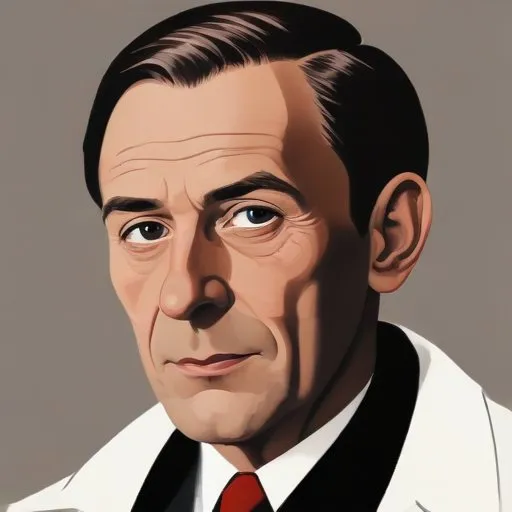
A pioneering Dadaist and Surrealist, he explored the intersection of art and film, creating innovative experimental works that pushed boundaries. His avant-garde style influenced generations of artists and filmmakers.
Hans Richter, a German-born painter, graphic artist, filmmaker, and art historian, is renowned for his pioneering contributions to the Dada movement, a revolutionary art phenomenon that rejected traditional aesthetics and sought to create new, unconventional forms of expression. Richter's work spanned multiple disciplines, influencing intellectuals and artists across various fields, making him a catalyst for avant-garde art in the 20th century.
Born on April 6, 1888, in Berlin, Germany, Richter came from a well-to-do family. He began his artistic journey at the Academy of Fine Art in Berlin (1908) and later at the Academy of Fine Art in Weimar (1909). His early exposure to Modern Art came through the Blaue Reiter in 1912 and the Erster Deutscher Herbstsalon gallery Der Sturm in Berlin in 1913.
In 1916, Richter's first exhibition took place in Munich, which was followed by a special edition of Die Aktion, a periodical he contributed to. That same year, he was wounded and discharged from the army, leading him to Zurich, where he met Tristan Tzara, Marcel Janco, Jean Arp, and Hugo Ball, who were forming the Dada movement. Richter's artistic philosophy aligned with the Dadaist ideology, which rejected traditional art forms and sought to create new, provocative works that challenged societal norms.
As a co-founder of the Association of Revolutionary Artists (Artistes Radicaux) in Zurich (1919), Richter collaborated with artists like Viking Eggeling, experimenting with film. His first abstract art works emerged in 1917, showcasing his innovative approach to art. Richter's "Prrelude" (1919), an orchestration of a theme developed in eleven drawings, marked the beginning of his avant-garde explorations.
Richter's influence extends beyond the art world. He organized exhibitions that revived interest in Dada, both in the United States and Europe. In 1956, he created "Dadascope," a film dedicated to Dada poetry. His book "Dadaism" (1965) remains a seminal work on the history of the Dada movement.
Richter's work has inspired generations of artists, filmmakers, and writers. His innovative spirit, commitment to challenging traditional norms, and the emphasis on experimentation have made him a pioneer in the world of avant-garde art.
Richter's personal life was marked by significant events that shaped his artistic trajectory. His friendship with Franz Pfemfert, editor of Die Aktion, introduced him to the Berlin avant-garde circle. Richter's experience in World War I, where he was wounded and discharged, led him to Zurich, where he discovered the Dada movement.
Richter's later life was marked by a continued commitment to art and philosophy. He passed away on February 1, 1976, in Minusio, Switzerland, leaving behind a rich legacy that continues to inspire and provoke.
"Art is not a mirror held up to reality, but a hammer with which to shape it."
"The artist's duty is to be politically active by opposing war and supporting revolution."
Richter's work has been recognized and celebrated through various awards and honors, solidifying his position as a pioneer of avant-garde art.
Richter's artistic philosophy and innovative spirit have left an indelible mark on the art world. His contributions to Dadaism, Constructivism, and Neoplasticism have paved the way for future generations of artists, filmmakers, and writers. His legacy continues to inspire and provoke, ensuring that his work remains relevant and thought-provoking.
Richter's avant-garde approach to art has influenced various aspects of popular culture, from literature to music and film. His emphasis on experimentation and challenging traditional norms has inspired artists across disciplines, from David Bowie to Andy Warhol.
Born in 1871
A German-American painter and illustrator who blended cubism and futurism to create vibrant, abstracted cityscapes and seascapes, influencing the development of modern art.
Born in 1878
A Ukrainian painter and theorist who founded the Suprematist movement, creating geometric abstract works that explored the emotional and spiritual properties of color. They're most known for their iconic "Black Square" painting.
Born in 1866
A pioneer of abstract art, creating vibrant, expressive works that explored the emotional and spiritual properties of color, and wrote extensively on art theory.
Born in 1879
A Swiss-German artist and educator who blended fantasy and reality in his vibrant, whimsical paintings, exploring the emotional and expressive qualities of color. His unique style has inspired generations of artists.
Born in 1885
A pioneer of Orphism, a style of abstract art that emphasizes geometric shapes and vibrant colors, creating dynamic and expressive works that explore the emotional potential of color. 42
Born in 1883
A Dutch artist who founded the De Stijl art movement, characterized by geometric shapes and primary colors, and is known for his abstract paintings and architectural designs.
Born in 1895
A pioneering figure in modern art, known for blending traditional mediums with industrial materials and techniques to create innovative, avant-garde works that explored the intersection of art and technology.
