


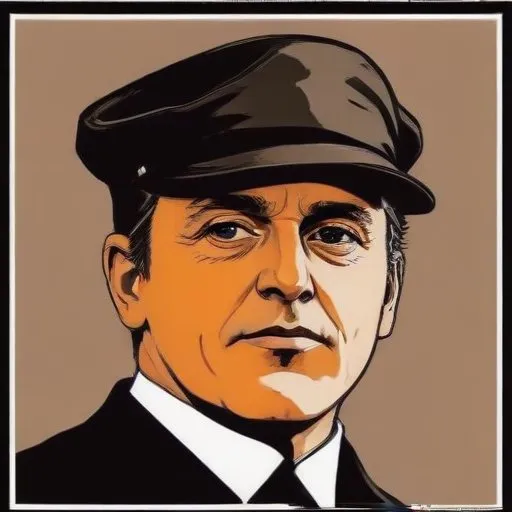
A renowned opera conductor and director, known for his innovative productions and interpretations of Mozart and Verdi operas. He was a pioneer in the revival of Mozart's operas in the early 20th century.
Fritz Busch was a renowned German conductor known for his meticulous approach to music and his bold stance against the Nazi regime. Throughout his career, he premiered numerous operas by prominent composers, including Richard Strauss, Ferruccio Busoni, and Kurt Weill, cementing his reputation as a champion of modern music.
Born on March 13, 1890, in Siegen, Westphalia, Fritz Busch was the eldest of eight children in a musical family. His father, Wilhelm Busch, was a carpenter, violin maker, and music shopkeeper, who supplemented the family's income by performing dance music on weekends. Fritz's early music lessons with his father and others laid the foundation for his future career. In 1906, he entered the Cologne Conservatory, where he studied harmony and counterpoint with Otto Klauwell and piano with other notable instructors.
After completing his studies, Busch served in the German army during World War I. Upon his return, he was appointed to senior posts in two prominent German opera houses: the Stuttgart Opera (1918-1922) and the Dresden State Opera (1922-1933). During his tenure, he introduced modern repertoire and premiered numerous operas by renowned composers. However, his anti-Nazi beliefs led to his dismissal from his post as director of the Dresden State Opera in 1933.
Forced to flee Germany, Busch continued his career abroad, conducting in New York, London, Buenos Aires, Copenhagen, and Stockholm. He became the musical director of the Teatro Colón in Buenos Aires, leading the opera company for several seasons in the 1930s and 1940s. In England, he founded the Glyndebourne Festival Opera, collaborating with stage director Carl Ebert to bring innovative productions to life.
Busch was known for his scrupulous approach to music, striving to do justice to the composers whose works he conducted. He detested showmanship, focusing instead on the nuances of the score. This approach earned him a reputation as a consummate musician and a pioneer of modern opera.
Busch was part of a talented family, with siblings who also pursued careers in music. His brother, Adolf Busch, was a renowned violinist, and his brother, Hermann Busch, was a cellist. Fritz Busch died on September 14, 1951, in London, at the age of 61, leaving behind a legacy as a pioneering conductor and a champion of modern music.
Fritz Busch's tireless advocacy for modern music and his bravery in the face of Nazi oppression continue to inspire generations of musicians and music lovers alike. His commitment to artistic excellence and his refusal to compromise his values in the face of adversity serve as a testament to the transformative power of music and the importance of standing up for one's beliefs.
Born in 1864
A renowned composer and conductor of the late Romantic era, known for his tone poems and operas that showcased his mastery of orchestration and expressive storytelling.
Born in 1860
A visionary composer and conductor who expanded symphonic music's emotional depth and complexity, creating works of profound beauty and intensity.
Born in 1886
A renowned German conductor and composer, he was a dominant figure in the Berlin Philharmonic, known for his intense and expressive performances of Beethoven, Brahms, and Bruckner. He was also a composer of symphonies and other works.
Born in 1888
A renowned German conductor, celebrated for his interpretations of Richard Wagner's operas, particularly his iconic performances of "Der Ring des Nibelungen" at the Bayreuth Festival.
Born in 1894
A renowned opera conductor and director, celebrated for his interpretations of Mozart, Wagner, and Strauss, leading top orchestras and opera houses worldwide.
Born in 1908
A renowned maestro who led the Berlin Philharmonic for over three decades, elevating its reputation through precise and dramatic performances. He's also famous for his numerous recordings and charismatic stage presence.
Born in 1902
A renowned German conductor, he led prestigious orchestras, including the Berlin Philharmonic, and was particularly acclaimed for his interpretations of Bruckner, Wagner, and Strauss.
Born in 1914
A renowned Hungarian-Austrian conductor and director, celebrated for his vibrant and expressive performances, particularly with the Berlin Radio Symphony Orchestra. He's also recognized for his innovative opera productions.
