


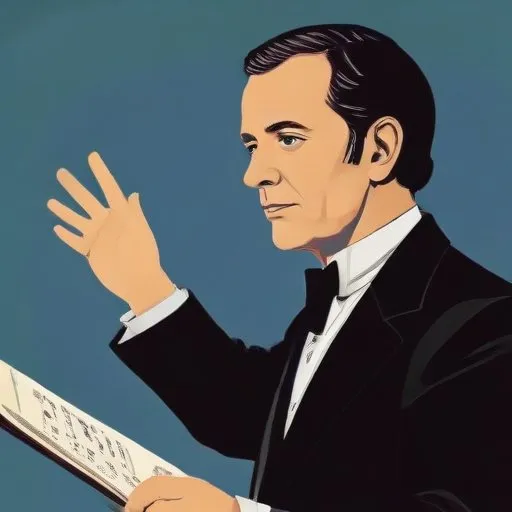
A renowned British conductor and composer, he led prominent orchestras and premiered works by notable composers, leaving a lasting impact on classical music.
Renowned for his immense contribution to the world of classical music, Sir Eugene Aynsley Goossens was an English conductor and composer who left an indelible mark on the industry. As a celebrated conductor, he was hailed for his innovative interpretations and seamless performances, earning him a reputation as one of the most esteemed maestros of his time.
Born into a musical family on May 26, 1893, in Camden Town, London, Goossens was the son of Eugène Goossens fils, a Belgian conductor and violinist, and Annie Cook, a Carl Rosa Opera Company singer. His early life was steeped in music, with his younger siblings and brothers all following in their father's footsteps to become accomplished musicians.
Goossens began his musical education at the tender age of ten in Bruges, followed by stints at the Liverpool College of Music and the Royal College of Music in London. It was during his time at the Royal College of Music that he won the silver medal of the Worshipful Company of Musicians and was made an associate of the institution.
Goossens' professional career began as a first violinist in Henry Wood's Queens Hall Orchestra from 1911 to 1915. He was later a founding member of the Philharmonic Quartet and served as Thomas Beecham's assistant conductor. His breakthrough performance came in 1916 with a rendition of Stanford's opera, The Critic.
In 1921, Goossens made the bold decision to pursue conducting as a career, founding his own orchestra and making several gramophone records for Edison-Bell's Velvet Face label. This was also the year he gave the British concert premiere of Igor Stravinsky's The Rite of Spring, with the composer present at the Queens Hall.
For nearly a quarter of a century, Goossens accepted positions at various U.S. orchestras. His first appointment was as conductor of the Rochester Philharmonic Orchestra from 1923 to 1931, during which time he also taught at the Eastman School of Music.
During the late 1920s, he frequently conducted for Vladimir Rosin's American Opera Company, an organization that grew out of the Eastman School. From 1931 to 1946, he succeeded Fritz Reiner as the conductor of the Cincinnati Symphony Orchestra, a tenure that cemented his reputation as a master conductor.
Sir Eugene Aynsley Goossens' contributions to classical music are immeasurable. He premiered numerous works, including those by renowned composers such as Igor Stravinsky, Dmitri Shostakovich, and Benjamin Britten. His impeccable conducting style, marked by precision and passion, inspired generations of musicians and audiences alike.
Throughout his illustrious career, Goossens received numerous accolades, including honorary doctorates from the University of Rochester and the Cincinnati College of Music. He was also appointed a Knight Bachelor in 1955 for his services to music.
Today, Goossens' legacy continues to resonate in the world of classical music. His dedication to the craft, his innovative spirit, and his commitment to nurturing young talent have left an indelible mark on the industry. As one of the most revered conductors of his time, Sir Eugene Aynsley Goossens remains an inspiration to music lovers everywhere.
Born in 1872
A renowned composer and educator, he's celebrated for his symphonies and folk-song inspired works that evoke a sense of English heritage and nostalgia. His music is a testament to his love for his homeland's cultural roots.
Born in 1902
A renowned composer of orchestral and choral works, particularly famous for his iconic score for Laurence Olivier's 1944 film "Henry V" and his ceremonial music for British coronations.
Born in 1908
A renowned maestro who led the Berlin Philharmonic for over three decades, elevating its reputation through precise and dramatic performances. He's also famous for his numerous recordings and charismatic stage presence.
Born in 1916
A renowned violinist and conductor who mesmerized audiences with his virtuosic performances and collaborations with esteemed musicians, also a passionate advocate for music education.
Born in 1918
A renowned musician who blended jazz, classical, and Broadway styles, creating iconic works like West Side Story, and inspiring generations with his charismatic performances and innovative compositions.
Born in 1897
A renowned conductor and composer, known for his precise and expressive performances, leading the Cleveland Orchestra to international acclaim. His interpretations of classical music remain highly influential.
Born in 1912
A renowned maestro who led the Chicago Symphony Orchestra to international acclaim, known for his intense performances and numerous recordings of operas and symphonies.
