


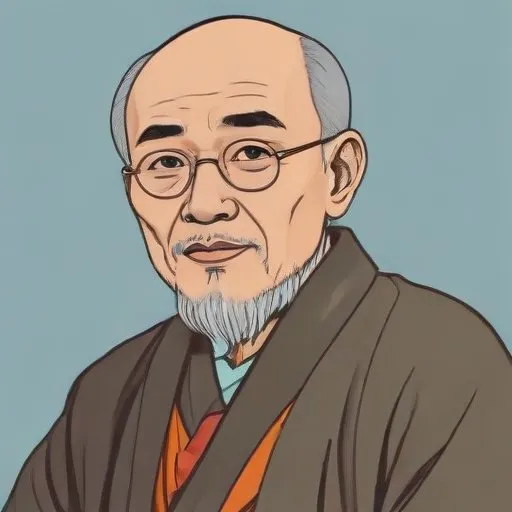
A prominent Chinese philosopher and academic who developed the concept of "New Confucianism," blending traditional Confucian thought with Western philosophy. His work has greatly influenced modern Chinese philosophy and intellectual history.
Feng Youlan, also known as Fung Yulan, was a Chinese philosopher, historian, and writer who played a pivotal role in reintroducing the study of Chinese philosophy in the modern era. He is best known for his monumental work, A History of Chinese Philosophy, which presented and examined the history of Chinese philosophy from a unique perspective influenced by Western philosophical traditions.
Feng Youlan was born on December 4, 1895, in Tanghe County, Nanyang, Henan, China, to a middle-class family. His younger sister, Feng Yuanjun, would later become a famous Chinese writer. Feng's early education took place at the China Public School in Shanghai, where he studied philosophy between 1912 and 1915. He then attended Chunghua University in Wuhan (later merged into Central China Normal University) and Peking University between 1915 and 1918, where he delved into Western philosophy and logic as well as Chinese philosophy.
Upon graduating in 1918, Feng traveled to the United States, where he studied at Columbia University on the Boxer Indemnity Scholarship Program. It was during this period that he met influential philosophers, including John Dewey, the pragmatist, who became his teacher. Feng earned his PhD from Columbia in 1923, with a thesis titled A Comparative Study of Life Ideals. He went on to teach at prominent Chinese universities, including Jinan University, Yenching University, and Tsinghua University in Beijing.
Feng's magnum opus, A History of Chinese Philosophy, was published in 1934 in two volumes. This seminal work presented a comprehensive history of Chinese philosophy, examining the development of philosophical thought from ancient times to the modern era. The book's influence was profound, shaping the study of Chinese philosophy for generations to come.
Feng's work extended beyond the realm of academic philosophy, influencing modern Chinese thought and culture. His emphasis on the importance of understanding Chinese philosophy in the context of Western philosophical traditions helped to bridge the gaps between East and West. As a result, his work has had a lasting impact on Chinese intellectual and cultural development.
Feng Youlan's writings are peppered with insights that continue to inspire and provoke thought. One of his most famous quotes is: "The history of Chinese philosophy is not a history of philosophical systems, but a history of philosophical problems."
Feng's philosophical contributions were characterized by his unique blend of traditional Chinese thought and Western philosophical approaches. He believed that Chinese philosophy was not a static entity, but a dynamic and evolving system that could be understood and appreciated through a nuanced and comparative approach.
Feng Youlan received numerous accolades for his contributions to Chinese philosophy and cultural development. He was awarded the prestigious Boxer Indemnity Scholarship, which enabled him to study at Columbia University.
Feng's life was marked by significant events that shaped his intellectual and personal journey. His encounter with John Dewey, his PhD studies at Columbia University, and his chairmanship of the Department of Philosophy at Tsinghua University were all pivotal moments that influenced his thought and career.
Feng Youlan's work can be compared to that of his contemporaries, such as Wing-tsit Chan, who also made significant contributions to the study of Chinese philosophy. While both scholars shared an interest in exploring the intersections between Chinese and Western philosophical traditions, Feng's emphasis on the importance of understanding Chinese philosophy in its own right set him apart.
Feng Youlan's influence extends beyond the academy, with his ideas and writings influencing Chinese literature, art, and culture. His emphasis on the importance of understanding Chinese philosophy has inspired generations of Chinese intellectuals and artists.
Feng Youlan's remarkable life and work have left an indelible mark on Chinese intellectual and cultural history. His contributions continue to inspire and influence scholars, philosophers, and artists around the world.
Born in 1868
A pioneering educator and reformer who transformed China's education system and promoted academic freedom, known for his advocacy of democracy and human rights.
Born in 1009
A renowned poet and essayist of the Song Dynasty, known for his lyrical and expressive writings that explored themes of nature, politics, and human emotions.
Born in 1898
The first Premier of the People's Republic of China, serving from 1949 until his death in 1976, is most known for his key role in the Chinese Communist Party and his diplomatic efforts to improve relations with the West. He played a crucial part in shaping China's foreign policy and economy during a pivotal period in the country's history.
Born in 1893
Leader of the Chinese Communist Party who implemented radical social and economic reforms, including the Great Leap Forward and the Cultural Revolution, shaping modern China's politics and economy.
Born in 1887
Led the Nationalist Party in China, fighting against the Communist Party and later establishing the government of Taiwan. He's known for his role in shaping modern Chinese history.
Born in 1866
A Chinese revolutionary who led the overthrow of the Qing dynasty and founded the Republic of China, known for his role in shaping modern China's government and politics.
