


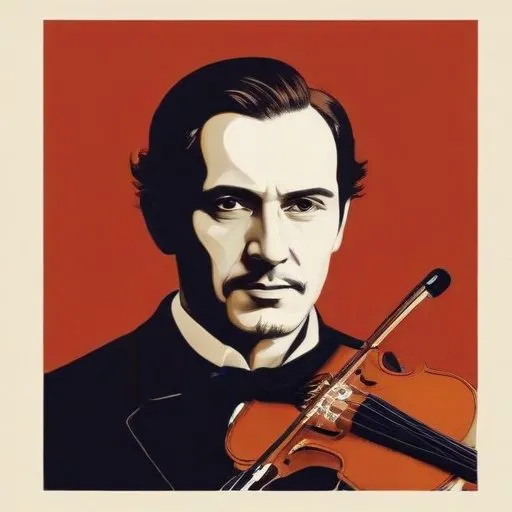
A Czech virtuoso violinist and composer, known for his technical mastery and expressive performances, leaving a lasting impact on the Romantic era's musical landscape.
Ferdinand Laub was a Czech violinist and composer, renowned for his exceptional talent and contributions to the world of classical music. He was hailed by none other than Pyotr Ilyich Tchaikovsky as the "best violinist of our time," a testament to his remarkable skill and artistry.
Laub was born on January 19, 1832, in Prague, to a German-Bohemian family that had assimilated into the ethnic Czech community. His father, Erasmus, recognized his son's prodigious talent and arranged for his first public appearance at the tender age of six. By the time Laub was ten, he was already performing solo concerts at the Stavovské divadlo, a prominent theater in Prague.
Laub's early training took place at the Prague Conservatory, where he studied from 1843 to 1846. He then embarked on a series of exhibitions across Europe, eventually becoming a professor at the Stern Conservatory in Berlin and Weimar from 1855 to 1862.
Laub's adult career as a virtuoso violinist took off in Vienna, where he performed at the imperial court. His travels took him to various parts of Europe, during which he was showered with accolades and recognition for his exceptional talent. He was particularly admired for his mastery of the violin, and his performances were often met with critical acclaim.
One of the highlights of Laub's career was his involvement in the premiere performances of Tchaikovsky's First and Second String Quartets. He also had the distinction of being the posthumous dedicatee of the composer's Third String Quartet, written in 1876.
In 1866, Laub became a professor of violin at the Moscow Conservatory, a position he held until 1874. During his tenure, he taught many notable students, including Stanisław Barcewicz. Laub's pedagogical influence was significant, and his students went on to become prominent musicians in their own right.
Ferdinand Laub's impact on the world of classical music was profound. He was not only an exceptional violinist but also a talented composer, leaving behind a body of work that includes concertante cadenzas, chamber music, and solo pieces for violin and piano.
Laub's legacy extends beyond his own compositions. He played a significant role in popularizing the works of other composers, including Tchaikovsky, and was instrumental in shaping the course of classical music in the late 19th century.
In 1874, Laub was forced to stop working due to his failing health, which was exacerbated by lung disease. He was succeeded at the Moscow Conservatory by Jan Hřmal. Laub passed away on March 17, 1875, while en route to a spa in Meran, and was buried in the Vyšehrad cemetery in Prague.
Despite his untimely passing, Ferdinand Laub's contributions to the world of classical music continue to resonate, inspiring generations of musicians and music lovers alike.
Born in 1841
A Czech composer and academic who blended folk influences with classical music, creating iconic works like the "New World Symphony".
Born in 1824
A Czech pianist and composer who is often referred to as the father of Czech national music, known for his operas and symphonic poems that evoke a strong sense of national identity.
Born in 1874
A Czech virtuoso violinist and composer, known for his romantic and expressive works, including his iconic Asrael Symphony, which showcases his mastery of orchestration and emotional depth.
Born in 1870
A Czech composer and educator who blended folk elements with modernist techniques, creating a unique national style in his orchestral and chamber works.
Born in 1850
A Czech Romantic-era composer and poet, known for his operas and symphonic poems that showcased his country's folklore and literature. His music is still widely performed in the Czech Republic today.
Born in 1854
A Czech composer and theorist who created innovative, folk-inspired operas and orchestral works that explored the human experience, often with a focus on social justice and morality.
Born in 1890
A Czech-American pianist and composer who blended neoclassicism and surrealism, creating innovative works that merged classical music with jazz and avant-garde elements.
Born in 1912
A Czech-American pianist and educator who taught at prestigious institutions, including the Juilliard School, and was known for his advocacy of modern classical music. He premiered numerous works by prominent composers.
