


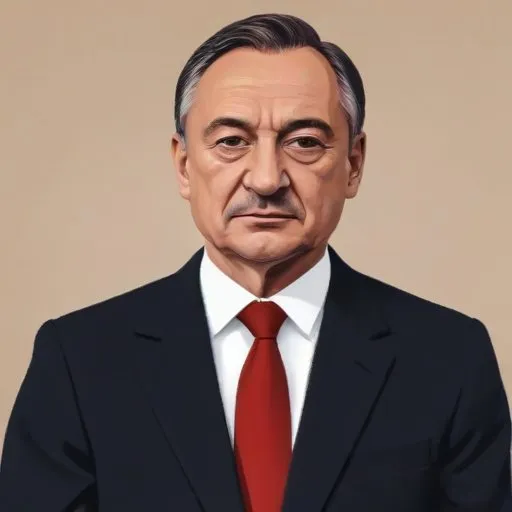
A Hungarian academic and politician who served as the 2nd President of Hungary, known for his efforts to transition the country from communism to democracy. He played a key role in shaping Hungary's post-communist era.
Ferenc Mádl, a prominent Hungarian legal scholar, professor, and politician, served as the President of Hungary from 2000 to 2005, leaving an indelible mark on the country's political landscape. His remarkable academic prowess and exemplary political career earned him a revered position in Hungarian history.
Born on January 29, 1931, Mádl pursued higher education at the Faculty of Law of the Eötvös Loránd University, where he obtained his diploma in 1955. He furthered his studies at the University of Strasbourg, specializing in international comparative law between 1961 and 1963.
Mádl's academic achievements are a testament to his dedication to the field of law. He was awarded the title of Candidate of Politics and Law in 1964 and later earned his doctorate in 1974 with his dissertation The Company and Economic Competition in the Law of European Economic Integration. His work primarily focused on civil law, private international law, and legal issues related to international economic relations, as well as European law.
In recognition of his contributions, Mádl was elected a corresponding member of the Hungarian Academy of Sciences in 1987 and subsequently became a full member in 1993. He also held various prestigious positions, including secretary of the Scientific Qualifying Committee (1984-1990), member of the Harvard Academy of International Commercial Law (1985), and member of the steering committee of the Rome-based international institute UNIDROIT for unifying private law (1988).
Mádl's foray into politics began with his appointment as Minister without Portfolio in the conservative cabinets of József Antall and Péter Boross between 1990 and 1993. He then served as Minister of Education from 1993 to 1994. His first attempt at the presidency in 1995 was unsuccessful, but he ultimately won the election in 2000, becoming the President of Hungary.
During his presidency, Mádl played a pivotal role in shaping Hungary's domestic and foreign policies. He actively promoted European integration, strengthened Hungary's relationships with neighboring countries, and championed the cause of Hungarian minorities abroad. His commitment to education and culture led to significant investments in these sectors, yielding long-term benefits for Hungarian society.
Mádl's exceptional achievements were recognized with numerous awards and honors. He was awarded the Grand Cross of the Order of Merit of the Republic of Poland (2002), the Grand Cross of the Order of the White Rose of Finland (2003), and the Grand Cross of the Order of the Aztec Eagle (2004), among others.
Ferenc Mádl passed away on May 29, 2011, leaving behind a rich legacy that continues to inspire future generations. His remarkable life serves as a testament to the power of dedication, hard work, and commitment to public service.
Ferenc Mádl's enduring legacy continues to shape Hungary's political and academic landscape, serving as a beacon of inspiration for scholars, politicians, and citizens alike.
Born in 1922
First President of Hungary, a prominent figure in the country's transition from communism to democracy, known for his literary and political contributions.
65 Years Old
Hungary's 6th Prime Minister, a key figure in the country's transition to democracy, known for his economic reforms and leadership during the 2006 protests.
63 Years Old
The 38th Prime Minister of Hungary, known for his nationalist and conservative policies, has been a dominant figure in Hungarian politics for over two decades, shaping the country's identity and relationship with the EU.
94 Years Old
The 37th Prime Minister of Hungary, serving from 1994 to 1998, known for his efforts to transition the country from communism to a market economy and joining NATO. He implemented significant economic reforms and played a key role in Hungary's integration into Western institutions.
58 Years Old
The 7th Prime Minister of Hungary, a key figure in the country's economic reforms, known for his efforts to stabilize the economy during the 2008 financial crisis.
