


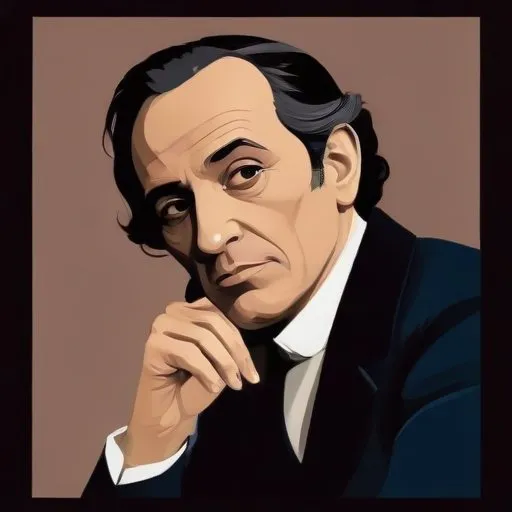
A 17th-century Venetian composer who revolutionized opera with his innovative and expressive style, creating over 40 operas that showcased his mastery of harmony and melody.
Francesco Cavalli, born Pietro Francesco Caletti-Bruni on February 14, 1602, was a renowned Venetian composer, organist, and singer of the early Baroque period. He is best known for succeeding his teacher Claudio Monteverdi as the dominant opera composer of the mid-17th century, leaving an indelible mark on the world of opera.
Born in Crema, a province of the Venetian Republic, Cavalli began his musical journey as a singer boy soprano at St. Mark's Basilica in Venice in 1616. Under the tutelage of Claudio Monteverdi, he honed his skills, becoming second organist in 1639 and eventually first organist in 1665.
Cavalli's operatic career began to take shape in 1639 with the premiere of Le nozze di Teti e di Peleo, soon after the first public opera house, the Teatro San Cassiano, opened in Venice. His subsequent operas, such as Ormindo (1644), Giasone (1649), and La Calisto (1651), solidified his reputation as a master composer.
His success led to an invitation to Paris in 1660, where he revived his opera Xerse and produced Ercole amante during his two-year stay.
Cavalli's operas revolutionized the genre by introducing melodious arias and popular types into his libretti. His works showcased a strong sense of dramatic effect, great musical facility, and a characteristic grotesque humor that defined Italian opera for centuries to come.
Unlike Monteverdi's early operas, scored for the extravagant court orchestra of Mantua, Cavalli's operas adapted to the limitations of public opera houses, utilizing a small orchestra of strings and basso continuo.
Cavalli's contributions to the development of public opera in mid-17th century Venice were invaluable. He not only dominated the operatic scene but also inspired a new generation of composers.
His operas continue to be celebrated for their dramatic intensity, musical inventiveness, and historical significance, making him a central figure in the evolution of opera.
Cavalli took the name Cavalli from his patron, Venetian nobleman Federico Cavalli, a testament to the significant support he received from the aristocracy.
Francesco Cavalli passed away on January 14, 1676, at the age of 73, leaving behind a rich legacy that continues to influence opera to this day.
Through his remarkable body of work, Cavalli ensured that his name would be etched in the annals of history, forever changing the course of opera and music.
These select operas represent a glimpse into Cavalli's prolific output, showcasing his mastery of the genre and his enduring impact on the world of opera.
Born in 1567
A Baroque music pioneer who revolutionized the opera and sacred music genres with innovative harmonies and orchestration, leaving an indelible mark on classical music.
Born in 1585
A renowned Baroque composer and organist, known for his contributions to the development of the oratorio and passion genres, creating over 500 works that showcased his mastery of choral music.
Born in 1678
A virtuosic violinist and prolific composer, he crafted over 400 concertos, including "The Four Seasons," which remains a beloved and iconic masterpiece of classical music.
Born in 1710
A Baroque composer, violinist, and organist who made significant contributions to the development of opera and sacred music, particularly with his famous "Stabat Mater" composition.
Born in 1685
A renowned Baroque composer and organist, famous for creating majestic orchestral suites, operas, and oratorios, including the iconic "Messiah" masterpiece.
Born in 1685
A virtuosic harpsichordist and composer, renowned for crafting over 550 sonatas that showcased his innovative and expressive style, blending Italian and Portuguese influences. 42
Born in 1619
A 17th-century Venetian composer and singer-songwriter, known for her innovative and expressive works, particularly in the genres of opera and cantata. She was one of the first women to compose large-scale operas.
