


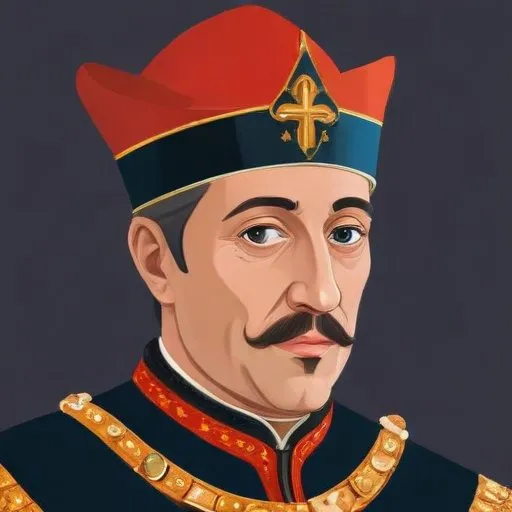
Ruler of Milan from 1521 to 1535, known for his military campaigns and cultural patronage, particularly in the arts and architecture.
Francesco II Sforza, the last member of the Sforza family to rule Milan, is best known for being the Duke of Milan from 1521 until his death in 1535. He was a key figure in the Italian Wars and played a significant role in shaping the history of Milan and Italy as a whole.
Francesco was born on February 4, 1495, to Ludovico Sforza and Beatrice d'Este. When his father was ousted from Milan, Francesco was taken to the court of Emperor Maximilian I, where he was assigned to an ecclesiastical career.
However, fate had other plans for Francesco. When Charles V reconquered Milan from the French in 1521, Francesco was appointed as the Duke of Milan, making him the last of the Sforza family to hold the title.
Francesco fought in several military campaigns, including the Battle of Bicocca in 1522, where he fought on the side of the emperor. Later, in 1526, he switched sides and joined the League of Cognac, alongside Francis I of France, Pope Clement VII, and the Republic of Florence.
In 1534, Francesco married Christina of Denmark, the 12-year-old niece of Charles V. The union remained childless, and Francesco's death in 1535 sparked the Italian War of 1535.
Despite his relatively short reign, Francesco II Sforza played a significant role in shaping the history of Milan and Italy. His efforts to promote cultural and economic recovery in Milan after years of war helped to lay the foundation for the city's future growth and prosperity.
Francesco II Sforza's reign marked the end of the Sforza dynasty's rule in Milan, which had lasted for over a century. His death led to a series of power struggles and wars that would shape the fate of Italy for centuries to come.
Despite the challenges he faced during his reign, Francesco II Sforza's legacy as a ruler and a military leader continues to be felt to this day. His efforts to promote cultural and economic recovery in Milan helped to lay the foundation for the city's future growth and prosperity.
Born in 1452
Ruler of Milan who commissioned Leonardo da Vinci's famous painting, The Last Supper, and was a patron of the arts and architecture.
Born in 1469
Ruler of Milan who transformed the city into a cultural and economic hub, commissioning grand architectural projects and fostering a Renaissance humanist movement.
Born in 1494
The queen who brought Italian Renaissance culture to Poland, introducing new agricultural practices and promoting education, and was a shrewd politician who protected her family's interests.
Born in 1474
Renowned for epic poems, particularly "Orlando Furioso", which masterfully blended chivalric romance and Renaissance humanism, influencing literature for centuries.
Born in 1452
Renaissance mastermind behind iconic works like the Mona Lisa and The Last Supper, who revolutionized art, science, and engineering with his inventive and curious nature.
Born in 1475
A ruthless and cunning politician who rose to power in the Renaissance era through intrigue and military conquest, leaving a lasting legacy in politics and governance.
Born in 1535
The second shortest-reigning pope in history, serving for just 27 days in 1605, he is most known for his brief but tumultuous papacy marked by power struggles and controversy.
