


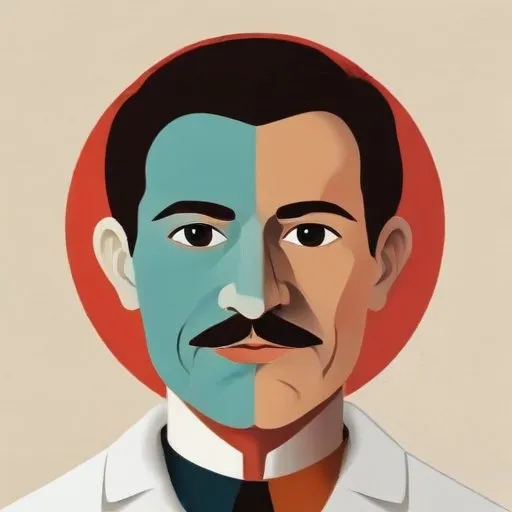
A 16th-century physician who wrote extensively on anatomy, physiology, and pharmacology, and is considered one of the founders of modern neurology. His works remained influential for centuries.
Francisco Valls, also known as Divino Valls Covarrubias, was a Spanish physician who embodied the essence of the medical Renaissance in Spain. He is renowned for being the chief physician of King Philip II of Spain, and his contributions to the field of medicine, humanism, and literature.
Born on October 4, 1524, in Burgos, Spain, Valls studied in various European cities, where he came into contact with the likes of Andrea Vesalius. This exposure greatly influenced his medical career, and he went on to become the Mdico de Cmara y Protomdico General de los Reinos y Seoros de Castilla, or the chief physician of the Medical and General Chamber of Kingdoms and Dominions of Castile.
Valls was a prolific writer, and his works include:
Valls' contributions to medicine, humanism, and literature have left a lasting impact on the world. He is remembered as:
In recognition of his achievements, the Spanish botanists Ruiz and Pavn named a South American shrub, Vallesia, in his honor in 1794.
Valls spent his later years in the apothecary's Monastery of El Escorial, where medicines were prepared by distillation of natural plants. He died on September 20, 1592, in Burgos, and is buried in the chapel of Colegio Mayor de San Ildefonso in Alcal de Henares.
Valls' legacy continues to inspire generations of medical professionals, humanists, and writers. His contributions to the field of medicine, philosophy, and literature have cemented his place in history as a true Renaissance man.
Born in 1514
A pioneering figure in the study of human anatomy, known for performing detailed dissections and creating accurate drawings of the body's inner workings, revolutionizing medical understanding.
Born in 1564
Pioneering astronomer, physicist, and mathematician who played a major role in the Scientific Revolution, making key discoveries that challenged Aristotelian views and laid the foundation for modern science.
Born in 1578
Discovered the circulatory system and described how blood flows through the body, revolutionizing understanding of human physiology.
Born in 1596
Developed influential philosophical and mathematical concepts, including the famous phrase "I think, therefore I am," and laid the foundation for modern Western philosophy.
Born in 1632
Pioneering microbiologist who discovered microorganisms like bacteria, yeast, and protists, laying the foundation for modern microbiology.
Born in 1852
Pioneering neuroscientist and pathologist who discovered the structure of neurons and pioneered the field of neuroscience, earning a Nobel Prize in Physiology or Medicine in 1906.
