


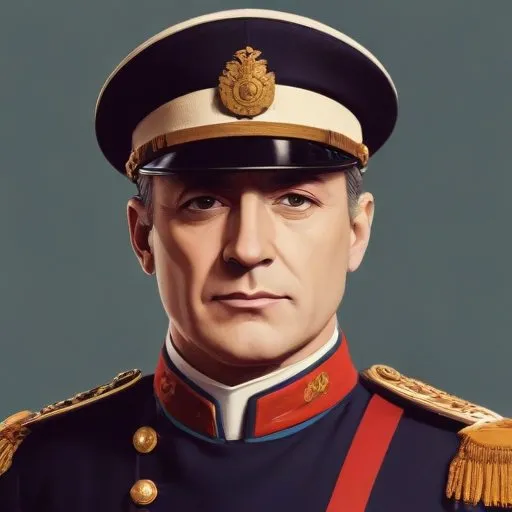
A brilliant military strategist and one of Napoleon's most trusted generals, known for his bravery and tactical genius on the battlefield.
Franois Joseph Lefebvre, Duke of Danzig, is renowned as one of the original eighteen Marshals of the Empire created by Napoleon, and a brilliant military commander of the French Revolutionary Wars and the Napoleonic Wars.
Born on May 28, 1755, in Rouffach, Alsace, Lefebvre was the son of a miller and retired hussar. Orphaned at a young age, he was raised by an uncle who attempted to guide him into a career in the church.
Lefebvre's military journey began in 1773 when he enlisted in the French Guards. Despite being a commoner, he rapidly rose through the ranks, promoted to corporal in 1777 and to sergeant in 1788. His dedication and valour caught the attention of his superiors, and he was transferred to a regular infantry regiment soon after.
Lefebvre was in Paris during the tumultuous Storming of the Bastille in 1789 and fervently embraced the French Revolution. He joined the newly formed National Guard of Paris, achieving the rank of lieutenant, and was wounded while defending King Louis XVI during a popular uprising.
At the outbreak of the War of the First Coalition in 1792, Lefebvre held the rank of captain. He rapidly advanced through the ranks, receiving his promotion to brigade general on December 2, 1793. He participated in the Battle of Fleurus on June 24, 1794, and served on the Rhine front for the next few years.
After General Lazare Hoche's death in September 1797, Lefebvre was appointed commander of the Army of Sambre and Meuse. He then commanded the vanguard of the Army of the Danube under Jean-Baptiste Jourdan in March 1799. Napoleon, impressed by Lefebvre's unwavering dedication and military prowess, appointed him as one of the original eighteen Marshals of the Empire in 1804.
Lefebvre's remarkable military career, coupled with his unwavering loyalty to Napoleon and the French Empire, cemented his place in history as one of the most revered Marshals of the Empire. He died on September 14, 1820, leaving behind a legacy of bravery, honour, and military genius.
Lefebvre married Cathrine Hbscher in 1783 and had 14 children, although all predeceased him. Despite his personal losses, he remained devoted to his family and country, earning the respect and admiration of his contemporaries.
Lefebvre's quotes and sayings reflect his pragmatic approach to warfare and his understanding of the importance of adaptability in the face of uncertainty.
Lefebvre's military campaigns and strategies have influenced modern military tactics, and his legacy continues to inspire military leaders and historians alike. His commitment to the French Empire and his role in shaping European history have left an indelible mark on modern society.
Born in 1769
A French military leader who rose to prominence during the French Revolution and became Emperor of France, known for his military conquests and reorganization of Europe. He is also famous for his Napoleonic Code, which remains a foundation of modern law.
Born in 1767
A flamboyant and daring cavalry commander who played a key role in Napoleon's military conquests, earning the title of King of Naples.
Born in 1770
A renowned military strategist and statesman who played a crucial role in Napoleon's conquests and later became a key figure in French politics, known for his exceptional organizational skills and bravery.
Born in 1758
A skilled military strategist and one of Napoleon's most trusted generals, known for his victories in the Peninsular War and his role in shaping modern warfare.
Born in 1769
A skilled military strategist and one of Napoleon's most trusted generals, known for his bravery and tactical genius on the battlefield.
Born in 1763
French admiral who commanded the combined French and Spanish fleet during the Napoleonic Wars, ultimately defeated at the Battle of Trafalgar in 1805.
Born in 1774
A skilled military leader who played a key role in Napoleon's army, earning the title of Marshal of France and governing Illyria. He's also known for his memoirs, which provided valuable insights into Napoleon's reign.
