


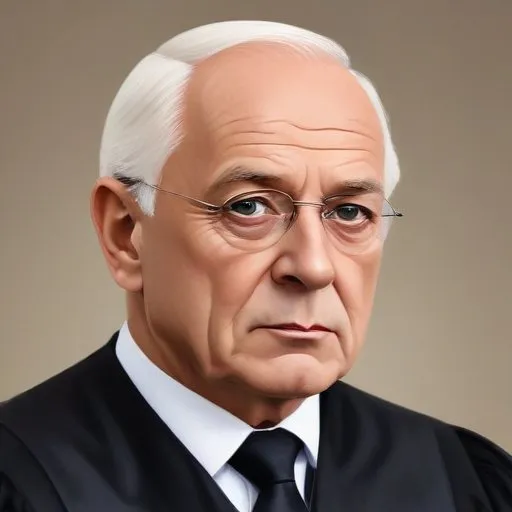
A high-ranking Nazi official who oversaw the judiciary system and played a significant role in implementing the Nuremberg Laws, which stripped Jews of their citizenship and civil rights.
Franz Schlegelberger, a name synonymous with the darkest period of German history, was the State Secretary in the German Reich Ministry of Justice and later, the Justice Minister of the Third Reich. He is infamous for his involvement in the Nazi regime's atrocities, making him the highest-ranking defendant at the Judges' Trial in Nuremberg.
Born on October 23, 1876, in Königsberg, Schlegelberger came from a Protestant family of salespeople. He pursued higher education at the University of Königsberg, earning a Doctor of Law degree in 1899. Subsequently, he passed the state law examination in 1901 and began his career as a court Assessor at the Königsberg local court.
Schlegelberger's rapid ascent in the judiciary was marked by several key appointments. In 1904, he became a judge at the State Court in Lyck (now Ełk), and in 1908, he joined the Berlin State Court as an assistant judge at the Berlin Court of Appeals (Kammergericht). His expertise and ambition earned him a position as a councilor at the Kammergericht in Berlin, where he served until 1918.
In 1918, Schlegelberger became an associate at the Reich Justice Office, and by 1922, he was teaching as an honorary professor at the University of Berlin's Faculty of Law. His academic pursuits complemented his growing influence in the government, culminating in his appointment as Ministerial Director in the Reich Ministry of Justice in 1927.
Schlegelberger's affiliation with the Nazi Party began in 1938, when he joined at the behest of Adolf Hitler. As State Secretary in the Reich Ministry of Justice, he worked closely with Justice Minister Franz Görtner until the latter's death in 1941. Following Görtner's passing, Schlegelberger assumed the role of Justice Minister, solidifying his position as a key figure in the Nazi regime.
During his tenure, Schlegelberger was instrumental in drafting several notable legal reforms, including a bill aimed at introducing a new national currency to combat hyperinflation. Though his involvement in the Nazi Party's atrocities was significant, Schlegelberger's own ideology was shaped by his commitment to National Socialism.
In the aftermath of World War II, Schlegelberger was put on trial at the Judges' Trial in Nuremberg, where he faced charges of war crimes and conspiracy to commit war crimes. Ultimately, he was sentenced to life imprisonment, marking a rare instance of accountability for those involved in the Nazi regime.
Franz Schlegelberger's legacy serves as a stark reminder of the dangers of unchecked power and ideological extremism. His involvement in the Third Reich's atrocities indelibly marks his place in history, serving as a cautionary tale for generations to come.
Born in 1893
A ruthless and notorious judge who presided over the Nazi's People's Court, sentencing thousands to death during World War II, earning him the nickname "Hanging Judge".
Born in 1900
Leading the SS and Gestapo, he oversaw the Nazi regime's brutal security apparatus and implemented the "Final Solution," orchestrating the genocide of six million Jews during World War II.
Born in 1893
A high-ranking Nazi official, he was a decorated World War I fighter pilot and later became a prominent politician, serving as Minister President of Prussia. He's infamous for his role in the Nazi regime and war crimes trials.
Born in 1893
A German diplomat who served as the Nazi regime's Foreign Minister, orchestrating key alliances and treaties that led to World War II. He was a close associate of Adolf Hitler and played a crucial role in shaping Nazi foreign policy.
Born in 1882
A high-ranking Nazi officer who served as the Chief of the OKW, the German High Command, during World War II, and was known for his unwavering loyalty to Hitler. He was tried and executed for war crimes after the war.
Born in 1890
Chief of the German High Command during World War II, responsible for planning and executing military operations, and signing the unconditional surrender of Germany.
Born in 1876
A German naval leader who played a key role in the Kriegsmarine during World War II, overseeing the German U-boat fleet and naval operations. He was a close advisor to Adolf Hitler and implemented the German naval strategy during the war.
Born in 1891
A German naval commander who led the U-boat fleet during World War II and briefly served as President of Germany after Hitler's death, known for his role in the war and its aftermath.
