


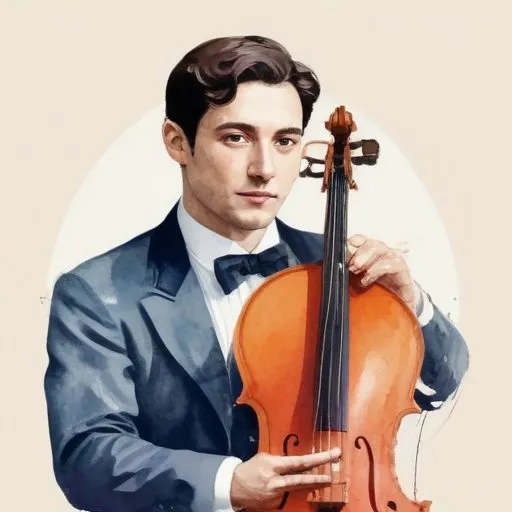
Austrian musician and composer who excelled in multiple genres, including chamber music and opera, and is particularly renowned for his orchestral works, especially his symphonies.
Franz Schmidt was a renowned Austrian composer, cellist, and pianist, known for his exquisite works that blended traditional Austro-Hungarian elements with modernist influences. Born on December 22, 1874, in Pressburg, Austria-Hungary (now Bratislava, Slovakia), Schmidt's life was a testament to his passion for music and his pursuit of artistic excellence.
Schmidt's early life was marked by a strong musical foundation, thanks to his mother, Mria Ravasz, an accomplished pianist who provided him with systematic instruction in keyboard works of J. S. Bach. He later received theoretical guidance from Felizian Josef Moczik, the organist at the Franciscan church in Pressburg.
In 1888, Schmidt moved to Vienna with his family and pursued his musical education at the Vienna Conservatory. There, he studied composition with Robert Fuchs, cello with Ferdinand Hellmesberger, and counterpoint with the legendary Anton Bruckner. Schmidt's exceptional talent earned him a graduation with excellence in 1896.
Schmidt's professional career was a testament to his dedication and versatility. He secured a position as a cellist with the Vienna Court Opera Orchestra, where he played until 1914, often under the baton of Gustav Mahler. Schmidt's exceptional skill earned him the distinction of playing all the cello solos, even though Friedrich Buxbaum was the principal cellist.
In addition to his work with the orchestra, Schmidt was in high demand as a chamber musician. His cordial relationships with influential composers like Arnold Schoenberg, despite their vastly different styles, demonstrate Schmidt's ability to bridge artistic gaps.
Schmidt's compositions, although lesser-known than those of his contemporaries, showcase his unique blend of traditional and modern elements. His works, such as the orchestral suite Notre Dame, his Symphony in A major, and the opera Fredigundis, demonstrate his mastery of form and his ability to evoke powerful emotions.
As a professor of piano at the Vienna Conservatory, Schmidt played a vital role in shaping the next generation of musicians. His teaching position, which he held from 1914 until his death in 1939, allowed him to impart his knowledge and passion to numerous students, leaving a lasting legacy in the world of music.
Despite his many accomplishments, Schmidt remained humble and kind. His friendship with Arnold Schoenberg, despite their artistic differences, speaks to his ability to form meaningful connections with others.
Schmidt's dedication to his craft was unwavering, and his passion for music continued to inspire those around him until his passing on February 11, 1939.
Franz Schmidt's multifaceted career, marked by excellence, innovation, and dedication, continues to inspire musicians and music lovers alike. His legacy serves as a testament to the power of artistic passion and the importance of nurturing talent.
Born in 1883
A pioneering figure in atonality and twelve-tone technique, revolutionizing classical music with concise, expressive works that explored new sounds and structures.
92 Years Old
A controversial radio host and lawyer who sparked heated debates with his outspoken views, ultimately becoming a martyr for free speech after a tragic assassination.
Born in 1874
A pioneer of atonality and 12-tone serialism, revolutionizing classical music with innovative compositions that pushed boundaries of harmony and melody.
Born in 1860
A visionary composer and conductor who expanded symphonic music's emotional depth and complexity, creating works of profound beauty and intensity.
Born in 1864
A renowned composer and conductor of the late Romantic era, known for his tone poems and operas that showcased his mastery of orchestration and expressive storytelling.
Born in 1860
A Slovene-Austrian composer who expanded the art of songwriting by setting poetic lyrics to music, creating a new level of emotional intensity and depth. His innovative compositions continue to influence classical music today.
Born in 1900
Austrian-American composer and educator who blended jazz and classical music, creating innovative operas and symphonies. Known for his eclectic style and influential teaching methods.
Born in 1897
A child prodigy turned Hollywood legend, he composed iconic film scores, including the swashbuckling adventures of Errol Flynn, and is revered for his lush, romantic music.
