


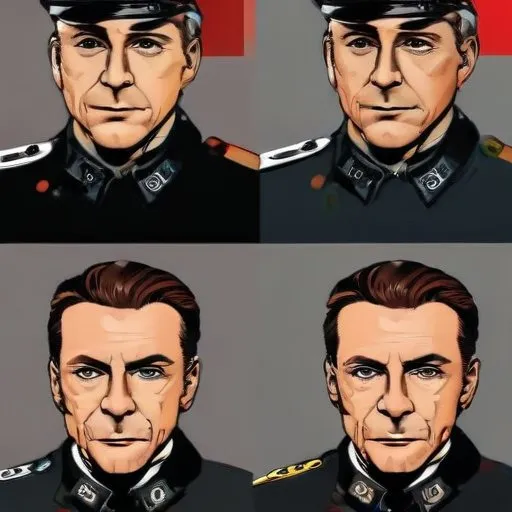
Austrian-German SS officer who served as the commandant of the Treblinka and Sobibor extermination camps during the Holocaust, responsible for the deaths of hundreds of thousands of people.
Franz Stangl, a German police officer, is infamous for his role as the commandant of the Nazi extermination camps Sobibor and Treblinka during World War II. He was responsible for the mass murder of approximately one million people, earning him the dubious distinction of being one of the most notorious perpetrators of the Holocaust.
Stangl was born on March 26, 1908, in Altmünster, Austria. His childhood was marked by a difficult relationship with his father, a night watchman, which left a lasting impact on his life. To support his family, Stangl learned to play the zither and gave lessons to earn money.
After completing his public schooling in 1923, Stangl secured an apprenticeship as a weaver and qualified as a master weaver in 1927. However, he soon became disillusioned with the trade and sought a new career. In 1930, he moved to Innsbruck and applied for an appointment in the Austrian federal police, drawn to the security and cleanliness represented by the police uniforms.
Stangl became a member of the Austrian Nazi Party in 1931, a move that would shape his future. He trained for two years at the federal police academy in Linz and was accepted into the police force in early 1931.
Stangl's Nazi affiliations led to his involvement in the T4 Euthanasia Program, a precursor to the Holocaust. He worked in various administrative positions, eventually becoming an SS commander in Nazi Germany.
In 1942, Stangl was appointed commandant of Sobibor, one of the most notorious extermination camps in Poland. He later became commandant of Treblinka, where he oversaw the mass murder of hundreds of thousands of people.
After the war, Stangl fled to Brazil, where he lived in hiding for 16 years. During this time, he worked for Volkswagen do Brasil, leading a seemingly ordinary life. However, in 1967, he was arrested and extradited to West Germany, where he was put on trial for his crimes.
In 1970, Stangl was found guilty of the mass murder of one million people and sentenced to life imprisonment. He died of heart failure just six months later, on June 28, 1971.
Franz Stangl's actions during World War II left an indelible mark on human history. His role in the Holocaust serves as a stark reminder of the dangers of hatred, discrimination, and state-sponsored violence. Stangl's story serves as a cautionary tale, highlighting the importance of promoting tolerance, understanding, and human rights.
Born in 1906
A high-ranking Nazi officer responsible for organizing the logistics of the Holocaust, overseeing the mass deportation of Jews to concentration camps during World War II.
Born in 1900
Leading the SS and Gestapo, he oversaw the Nazi regime's brutal security apparatus and implemented the "Final Solution," orchestrating the genocide of six million Jews during World War II.
Born in 1903
Austrian-German lawyer and general who served as the highest-ranking leader of the Nazi police forces, responsible for overseeing the Gestapo, SS, and concentration camps during World War II. He was a key figure in the Holocaust and other atrocities committed by the Nazi regime.
Born in 1911
A notorious physician and captain who conducted inhumane experiments on prisoners, particularly twins, during the Holocaust, earning the nickname "Angel of Death".
Born in 1913
Notorious Nazi war criminal and "Butcher of Lyon" responsible for thousands of deaths and brutal torture during World War II.
Born in 1912
A notorious SS officer responsible for the deportation of over 125,000 Jews to Nazi concentration camps during World War II, earning him the nickname "Eichmann's right-hand man".
Born in 1876
A German naval leader who played a key role in the Kriegsmarine during World War II, overseeing the German U-boat fleet and naval operations. He was a close advisor to Adolf Hitler and implemented the German naval strategy during the war.
Born in 1891
A German naval commander who led the U-boat fleet during World War II and briefly served as President of Germany after Hitler's death, known for his role in the war and its aftermath.
