


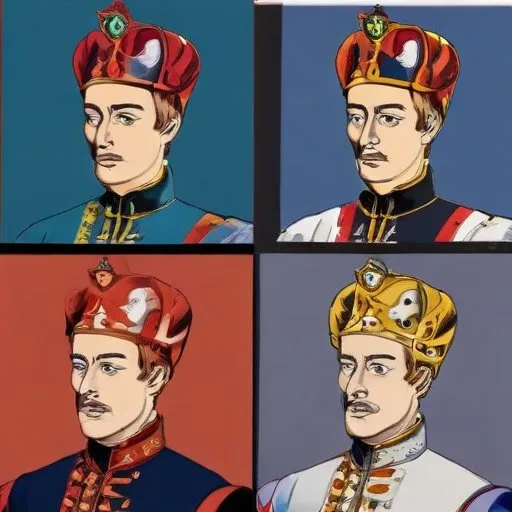
A 15th-century ruler who governed Lorraine, a region in northeastern France, and played a significant role in the Hundred Years' War. He's known for his military campaigns and territorial expansions.
Frederick IV, known as "The Fighter," was the Duke of Lorraine from 1312 until his death in 1328. He is remembered for his bravery and military prowess, earning him the respect of his contemporaries and leaving a lasting legacy in the history of Lorraine.
Born on April 15, 1282, in Gondreville, Frederick IV was the son of Theobald II and Isabella of Rumigny. He succeeded his father as the Duke of Lorraine in 1312, inheriting the title and the responsibilities that came with it.
In 1314, Frederick IV found himself embroiled in the struggle for the throne of the Holy Roman Empire. At the Diet of Frankfurt, the prince-electors failed to choose between Frederick the Handsome, the duke of Austria, and Louis IV of Bavaria, leading to a period of uncertainty and conflict. Frederick IV sided with his brother-in-law, Frederick the Handsome, who was eventually captured at the Battle of Mhldorf in 1322.
In 1324, Frederick IV participated in an expedition in Aquitaine against Edward II of England's estates, fighting alongside Charles IV of France. He later took part in the War of Metz in 1325 and 1326. Upon Philip VI of France's succession in 1328, Frederick IV joined forces with him and fought at the Battle of Cassel, where he ultimately met his demise.
In 1304, Frederick IV married Elisabeth of Austria, daughter of Albert I of Austria, with whom he had several children, including Rudolph, Margaret, and four others who died in childhood. His successor, Rudolph, went on to become the next Duke of Lorraine.
Frederick IV's military prowess and strategic alliances left a lasting impact on the history of Lorraine. His bravery in battle and his loyalty to his allies earned him the respect of his contemporaries, and his legacy continues to be felt to this day. Despite the turmoil and uncertainty that marked his life, Frederick IV remains an important figure in the history of Lorraine, remembered for his strength, courage, and unwavering commitment to his people.
Frederick IV's life was marked by conflict, uncertainty, and drama, but his bravery and loyalty to his people have ensured his place in history as one of the most influential figures of his time.
Born in 1543
A 16th-century French nobleman who ruled Lorraine and was a key player in the Wars of Religion, known for his diplomatic efforts to maintain independence from France.
Born in 1768
The last Holy Roman Emperor, who ruled from 1792 to 1806, oversaw the dissolution of the Holy Roman Empire and was a key figure in European politics during the Napoleonic Wars.
Born in 1500
Ruling over a vast empire from 1519 to 1556, he was a powerful and influential leader who played a crucial role in shaping European politics and religion. He is most known for his efforts to unify Christian Europe and defend it against the Ottoman Empire.
Born in 1503
The first Habsburg to rule the Holy Roman Empire, he unified Austria and introduced the concept of a hereditary monarchy, shaping European politics for centuries to come.
Born in 1557
A 16th-century Holy Roman Emperor who ruled over a vast territory, known for his diplomatic and military prowess in maintaining peace and stability during a tumultuous era.
