


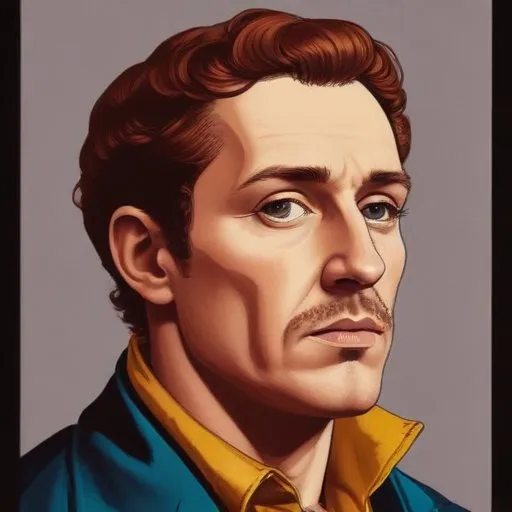
A prominent Victorian-era artist celebrated for his vivid, detailed illustrations and paintings, often featuring strong, independent women and mythological themes.
Frederick Sandys, born Antonio Frederic Augustus Sands in 1829, was a British painter, illustrator, and draughtsman, synonymous with the Pre-Raphaelite movement. His intricate and emotive works of art, often characterized by vivid colors and attention to detail, continue to captivate audiences to this day.
Sandys was born in Norwich, England, and received his earliest lessons in art from his father, Anthony Sands, who was also a painter. He was educated at Norwich School and later attended the Norwich School of Design in 1846. His talent was recognized by the Royal Society of Arts, which awarded him a silver medal in 1846 and a gold medal in 1847.
Sandys' artistic career flourished in the 1850s, with his work appearing in various publications, including the Illustrated London News. His association with the Pre-Raphaelite movement, a group of artists who sought to revive the style of the early Renaissance, brought him into contact with prominent figures such as Dante Gabriel Rossetti and John Everett Millais.
Sandys' oeuvre includes The Magdalen, a painting inspired by his mistress, Mary Emma Jones, and Loves Shadow, a work that showcases his mastery of color and composition. His portraits of women, often depicted in medieval or Renaissance attire, are characterized by their intricate details and emotional depth.
Sandys' personal life was marked by controversy, including a tumultuous marriage to Georgiana Creed and a long-term affair with Keomi Gray, a Romany woman who modeled for both him and Rossetti. He later entered into a common-law marriage with Mary Emma Jones, with whom he had numerous children.
Frederick Sandys' contributions to the Pre-Raphaelite movement and his influence on later artists, such as the Symbolists and the Aesthetic Movement, are undeniable. His work continues to inspire artists, art historians, and enthusiasts alike, offering a glimpse into the enigmatic world of Victorian England.
1829: Born in Norwich, England
1846: Attends Norwich School of Design
1847: Receives gold medal from the Royal Society of Arts
1850s: Begins association with the Pre-Raphaelite movement
1862: Meets Mary Emma Jones, his common-law wife
1904: Dies in Kensington, London
Frederick Sandys' life and art embody the essence of the Pre-Raphaelite movement, characterized by a deep appreciation for beauty, detail, and emotional depth. As we continue to explore the intricacies of his life and art, we are reminded of the profound impact he had on the art world and the enduring legacy he left behind.
Born in 1828
A Victorian-era poet and painter who founded the Pre-Raphaelite Brotherhood, creating dreamlike, sensual works that explored themes of love, beauty, and mortality.
Born in 1829
A renowned Pre-Raphaelite artist, famous for his exquisite and intricate paintings, particularly "Ophelia" and "Christ in the House of His Parents", which showcased his mastery of color and detail.
Born in 1827
A British soldier-turned-artist, he co-founded the Pre-Raphaelite Brotherhood, creating vivid, symbolic, and emotionally charged paintings that explored themes of faith, morality, and beauty.
Born in 1833
A leading figure in the Pre-Raphaelite movement, creating dreamlike, romantic, and mythological paintings that captivated the Victorian era. His works continue to inspire artists, designers, and writers to this day.
Born in 1819
A prominent art critic and social reformer who championed the Pre-Raphaelite movement and advocated for social justice, leaving a lasting impact on art, architecture, and literature.
Born in 1830
A renowned Victorian-era poet and author, celebrated for her lyrical and symbolic poetry, particularly "The Goblin Market and Other Poems" and "The Prince's Progress".
Born in 1837
A prominent Victorian-era writer, known for his poetic works that explored themes of beauty, death, and the human condition, with a distinctive style that blended sensuality and symbolism.
Born in 1834
A renowned artist and writer who revolutionized the Arts and Crafts movement with his stunning textiles, poetry, and novels, leaving a lasting impact on Victorian-era aesthetics.
